Tuesday, July 14, 2015

Riding the Nicaraguan Chicken Bus

Here in Nicaragua, we spend an enormous amount of time riding buses. Last week we went on vacation to the southeastern corner of Nicaragua and all told, spent almost thirty hours on either buses or boats. Given all of this time with nothing else to do but ponder the mystery of why it takes so damn long to get anywhere in a country the size of New York state, we've stockpiled quite a lot of data on the Nicaraguan public transportation system.

The first thing you need to know about Nicaraguan public transportation is that almost everyone uses it. Even people wealthy enough to own their own cars – who are certainly the minority of Nicaraguans – usually take the bus when they're not transporting a large object or a lot of people. The reason, of course, is that taking the bus is cheap; to travel 25 kilometers by bus from San Nicolas to Esteli only costs 15 cordobas, or 55 cents. So with a huge percentage of the population dependent on a public transportation system highly subsidized by the government, it is possible to travel cheaply almost anywhere in Nicaragua.

To get from place to place, then, you don't have to have a lot of money, but you do need to have time. There are two types of buses traveling between most major Nicaraguan cities: express buses and “ruteado” buses. Express buses are usually big and shiny on the outside, like charter buses in the US, and they can get you where you're going relatively quickly, with not many stops along the way.

Ruteados, on the other hand, take foreeeeeeever. Ruteados, or “chicken buses,” as they've been dubbed by tourists surprised by the abundance of farm animals permitted on public buses, are really just souped-up American school buses. After a certain number of years of carrying American children to and from school, these buses are deemed unsafe and are shipped off to Central America, where they are painted bright colors, modified so that they can carry more people, and sent on treacherous routes through rivers and up and down steep dirt roads. Many of the buses still have the original school bus signs attached above the driver's seat: “Your child's safety is our business.” These are mixed in with Jesus stickers and Spanish religious truisms: “No soy el dueño del mundo, pero si soy el hijo del dueño.” The bus from Esteli to La Garnacha has the label of the year that it was made: 1978.

With ruteado buses, you don't get tickets or assigned seats. This means that once the bus pulls up to the bus terminal, everyone races to get on, shoving each other aside or running to the back door, in an effort to get a seat. The least aggressive passengers are left standing in the aisle. The weird thing is that after all of this survival-of-the-fittest clawing and pushing dies down and everyone is settled into their places, people go back to being downright chummy with each other. If there is a mother standing in the aisle and holding her baby, a seated passenger will offer to hold the baby, and the mother hands her baby over to a complete stranger.

Because the bus owners earn money not based on how many trips they take, but on how many passengers ride the bus, they never turn anyone down. Even if the bus is completely packed to the gills, the bus driver will stop to let more people on. When the bus is really full, people ride on top of the bus. On the most packed bus I've ever ridden on, at one point I realized that I was standing obliquely, with my head not directly above my feet.

Ruteado buses also don't have specific bus stops. You can flag the bus down from anywhere along its route and it will stop to let you on. This makes it especially slow going, since often people will stand 20 feet away from each other so that the bus has to stop twice instead of just once. Another reason that ruteados take so long to get anywhere is that often, the bus driver will stop the bus and, without any warning, get off the bus for 15 or 20 minutes to have breakfast.

Every time the buses near a substantially-sized town, a huge horde of vendors climb on the bus and ride it until the next town, pushing their way through the passengers and advertising their wares in their own unique singsongs. “Helote helote heloooooote!” or “Tajadas y papitas, tajadas y papitas.” But it's not just food that they sell; they also sell some really strange things – fingernail clippers, medicine, moralizing booklets – and somehow, amazingly, the passengers buy these things. Sometimes the vendors give long, 10-minute spiels about whatever it is they're selling, always beginning by saying, “I know that it's rude to interrupt your journey, but please just give me a moment of your time.”

There are three things we've found in our extensive research into the Nicaraguan public transportation system that were true on almost every bus we've ridden. One is that buses always smell like corn. You might think that with so many people packed into such a small space, the buses would absorb an unpleasant body odor, but usually the pervading odor is just corn. The second rule is that buses almost always blare loud music. In this way, we've become overly-familiar with the favorite bachata, reggaeton, ranchera, and Christian tunes popular among many Nicaraguans. Sometimes, on the buses lucky enough to be endowed with flat-screen TVs, these tunes are accompanied by lewd music videos of almost-naked women shaking it while ugly men sing at them.

The final constant of every single Nicaraguan bus I've ever been on is the general good nature of all of the passengers. It is stunning to me how well people put up with extremely uncomfortable circumstances. I consider myself a person with a fairly high tolerance for discomfort, but I am like a whiny baby compared with most Nicaraguan bus-riders. When buses are so crowded that people's bodies are forced into weird corners and contortions, when the bus driver inexplicably stops for half an hour, when the bus is so hot that a sheen of sweat pastes your clothes to your skin – when any of these things happen, you don't hear a complaining peep out of a single passenger. This, I think, is the biggest lesson that the Nicaraguan public transportation system has to teach us.

Tuesday, June 30, 2015

Killing Chickens

On Sunday, in one of the most beautiful places imaginable, Davie killed his first chicken. There we were, in what could have been a child's drawing of mountains, the green humps of hills overlapping forever into the distance. And there was Davie, standing in front of a clump of chickens strung up by their feet on a tree branch, surrounded by Nicaraguan friends urging him on. It was the perfect paradigm: death in the midst of so much life.

Our friend Fatima, who works at the pharmacy next to our house, had been inviting us to kill chickens with her for quite a while. Last year she and three other women started a small poultry business as part of a class assignment for one of her agriculture classes. When they realized that there was a real demand for locally-grown chicken in this community, the group of women continued the business even after the class was over.

We have been buying Fatima's chicken when they slaughter a round of them every other month. It's good meat, tender with a strong chicken flavor. So we decided it was time for us to dispel the meat-eater's vague illusions about where meat really comes from. With this conviction in mind, we put on our boots and stomped bravely off to the farm.

When we got there, we realized that boots weren't the only chicken-killing articles we should have put on. We had assumed that there would be plastic aprons or ponchos at the ready, but everyone else was just wearing normal clothes, now completely covered in blood and chicken feathers.

Fatima showed us the different stations of the process. The 100 or so chickens that would be killed that day were held in a small building, where Fatima's brother was weighing each live chicken and then stuffing them into a big burlap sack. At six weeks of age, they all weighed around seven pounds, with the males weighing slightly more and the females slightly less. Fatima told me that this particular kind of chicken doesn't lay eggs. (Though I wondered if that was just because they were too young to lay eggs). They buy the chicks from a vendor in Esteli and feed them a mix of grains until they are large enough to slaughter.

The next step in the process was of course the most dire: slaughter. They took the chickens over to a structure made of three small tree branches tied together like a goal post and hung the chickens from their feet on the horizontal pole. Fatima took a knife and quickly slitted a chicken's throat. It flapped around a bit as the blood drained out of its neck, but it made less of a ruckus than I had expected. Then it was Davie's turn. He drew the knife once and then again across the chicken's throat, and then it was over. The chickens flapped about for a bit, spewing blood across their white feathers before finally going still. A dog lapped up the blood that trickled down the rocks below the dead chickens. (Later I saw a few egg-laying hens pecking about this same blood).

After the chickens were dead, they submerged them in a big pot of boiling water to remove the feathers. Then they took them into a sort of kitchen. After soaking them in ice water and picking off any remaining feathers, an assembly line of four or so people cut open the chickens and removed their organs. Some of the organs they kept (the liver, the heart, and the gullet), but the intestines they discarded. Then the chickens were divided into the various cuts that customers request – wings, breasts, legs, etc. For me, watching these whole chickens being hacked and gutted and taken apart was maybe the grossest part of the process.

That night for dinner we made ourselves some fresh-killed, honey-baked chicken, and it was delicious. Amazingly, after all that, I was no less disgusted to bite into a juicy bit of meat that only hours before had been a living animal. I'm not saying that eating meat is necessarily a good habit, but at least now I understand it a little better.

Monday, June 22, 2015

How to Dress for the Campo

Nicaraguans don't wear any kind of traditional clothing like many other Latin American cultures do. Instead, the distinctive style of dress that you find in the Nicaraguan campo comes directly from American used-clothes warehouses. When your local Value Village or Salvation Army can no longer sell certain items, they package them up into enormous, 60-pound "pacas," and ship them off to Nicaragua, where people buy individual pieces of clothing for around 50 cents.

This system of recycled clothes has drastically influenced the culture of style in every corner of Nicaragua. The hottest fashion around, worn by old women, little boys, and everyone in between, is a bright-colored t-shirt from Hollister, Abercrombie, or Aeropostale. These brands are so cool, in fact, that people sometimes sew their logos onto other items of clothing, or reinvent them with creative twists like "Hollixer" or "Aberpostale."

If you want to blend in in the Nicaraguan campo, here are a few fashion tips that you must follow.

1. Hollister goes well with horses.


2. Cowboy hats, leather boots, and big belt buckles are as Nicaraguan as traditional dancing.


3. If you don't like the wide brim, go for a baseball cap instead.


4. Undershirts are ideal get-up for street-lounging.


5. Everyone has to pick sides. Who will you choose?


6. Accessorizing your school uniform is simple with bright friendship bracelets and a trucker cap.


7. Respect the professional polo.


8. Long pencil skirts are perfect for every occasion - they bend with you!


9. Who needs undershirts? A sheer shirt is a sure shirt!


10. The higher the heel, the better.


11. Long hair is beautiful. Long hair in an elaborate braid is even more beautiful.


12. Plastic hair claws are WAY back in style. 


13. The head is an easel. Hair cuts are an art.


14. T-shirts with English words are always cool - it doesn't matter what they say!


Tuesday, June 9, 2015

The Magic of Cross-Cultural Connection

This past weekend David and I had the chance to be part of a cross-cultural exchange between high school students. Billy Byrnes, who was a VMM volunteer in San Nicolas before us, brought a group of American high school kids to San Nicolas for a few days to learn about what life is like in the Nicaraguan campo. This being quite an ambitious weekend goal, we set about packing in the cultural experiences.

When the students arrived on Thursday, we went to evening mass with them. They did a good job of enduring the long service, all in Spanish, with the occasional excitement: a stray dog bounding up to the front of the church, the congregation singing a Spanish, religified version of Bob Dylan's “Blowin in the Wind,” and of course the constant battle against flying ants.

On Friday the American students joined their Nicaraguan compatriots in their three-mile walk to school. This three miles is a daily stroll for many Nicaraguan high school students, but most of the Americans were completely worn out by the time they reached the paved road.

At school, we started the day with a ceremonial ribbon-cutting for the new athletic court roof. The mayor's office pulled out all the stops for this event, blaring patriotic music through human-sized stereos and hanging clumps of balloons from the court posts. After a few folkloric dances, Ruben Dario poems, and flowery speeches, we divided the American students into small groups and took them into the Nicaraguan classes, where we held Q and A sessions. We had the students ask each other questions about their various interests and high school experiences and then played a round of English/Spanish charades.

At first the Nicaraguan students especially were really shy about relating to the American students, but this shyness quickly dissolved during recess when they all got together to play soccer and basketball. By the time lunch rolled around, they all had crushes on each other. The Americans ate lunch with the Nicaraguan 11th grade class and the two groups performed for each other the songs in English that they had prepared for this occasion. This turned into an impromptu dance party that resulted in lots of bonding and, eventually when it was time for the Americans to leave, facebook name exchanging.

It was interesting for me to sit back and witness all of this, and to realize the profound differences in these kids' experiences. It was immediately obvious to me that the American kids, even though they were on turf that was not their own, all had so much more confidence in themselves than the Nicaraguans. The Americans were the ones asking all the questions during the Q and A; the Americans were also the ones who belted out their songs with little self-consciousness. Even though most of the American students had only taken high school Spanish classes just like the Nicaraguans had taken high school English, the Americans were far more advanced in their second language abilities. They were able to carry on basic conversations in Spanish whereas our Nicaraguan students were too embarrassed to utter even a single word in English.

But beyond all of this inequality and difference, a beautiful bond formed nonetheless. This felt immense. This felt like a true exchange. Both groups of students had so much curiosity about each other. Both groups overcame the smallness of their worlds to connect across cultural boundaries and wealth gaps, to reach a fuller sense of the what the world is. This is the idealist's dream.

For David and me, and for Billy too I think, this was an amazing opportunity to share that idealist's dream with these students. We have experienced the magic of cross-cultural connection during our two years here, and in doing so, we have come to cherish this community. We weren't sure if it would be possible for this group of students to form these bonds and realize the world-broadening power of cross-cultural exchange in a single weekend, but I think it was possible. A day of interaction can't form friendships that will survive the years, of course. But what I hope will survive in all of these students, American and Nicaraguan, is an awareness of a bigger world.

Wednesday, June 3, 2015

Feliz Dia de La Madre!

Nicaraguan women have crazy super powers. I have seen campo women grab, with their bare hands, a cast iron pot directly from a raging fire. I have seen a blind, 90-year-old woman walk miles over rocky terrain to reach the bus station. I have heard of a woman giving birth to 18 children, all in her own home, and then raising these children single-handedly. Considering these amazing feats of strength, it is no wonder that Mother's Day is one of Nicaragua's biggest holidays. (Though a single day could never make up for all of the hardships that these women suffer every day of their lives).

Around May 30th every year, you see people rushing around with big white cardboard boxes that contain the obligatory Mother's Day cake. In school, students make decorative Mother's Day bulletin boards with generic pictures of mothers that they printed off from the internet. And in every house – Catholic or Evangelical, rich or poor – people find a way to celebrate their mothers.

In honor of Nicaraguan Mother's Day, we want to celebrate the woman who has been like a Nicaraguan mother to us: Idalia Lopez Camas. As the principal at the San Nicolas high school, Idalia has been our main supervisor, but she has also been one of our best friends. When we were first in San Nicolas we went to Idalia for everything, and like a good mother, she helped us in every way she could: patiently explaining the school system, relaying the San Nicolas bus schedule, bringing over a big bag of beans and teaching us how to make Nicaraguan rice and beans. For every request we made, Idalia would do her characteristic thinking head-wobble and figure out some way to help us.

As the school principal, Idalia is one of the few women in San Nicolas who hold prominent positions in the community. But she certainly doesn't do it for the glory; Idalia's fervor for education has driven her entire life. In a time and place when Nicaraguan women were excluded from school without a second thought, Idalia earned her high school and college degrees by walking more than 12 miles to Esteli to take classes. She told me that once her shoe wore out while she was walking, so she walked into the city barefoot.

After she had married, when she had young children and was living in the tiny community of La Garnacha, Idalia taught elementary school classes during the day. High school classes weren't offered at that time. So, realizing how empowering it could be for these campo folks to get a high school education, Idalia started giving high school classes in the evenings. She wasn't even paid for this second job. But because of her conviction that education was the path to a better life for her neighbors, Idalia volunteered her evenings to teach high school.

Idalia's belief in the power of education lives on today. Her oldest daughter just graduated from college with a degree in pharmacy, and her younger two daughters are both in good school programs in Esteli. Even Idalia herself has dreams of going back to college to get a second degree.

Idalia is also the only person in San Nicolas who seems to have any authority over teenagers. Often our students will be running around, yelling and passing notes and being generally rambunctious when suddenly a silence will fall over the entire class. When we look up, Idalia is inevitably at the door, glaring in with the sternest face I've ever seen. Sometimes I almost feel like I'm in trouble. But the second the students leave, Idalia looks at me and bursts into laughter as if to say, “Ha! Did you see how angry they thought I was?”

I've also discovered that for some reason Idalia loves to make me laugh. She'll say something in the teacher's lounge and covertly glance over to see if I heard her joke. Even if I didn't understand her fast Spanish, I'll usually crack a smile, which I know feeds her hilarity, so that she'll build on her joke. One day when this happened, Idalia said to all of the other teachers in the room, “Look, I made Sarah laugh! She thinks I'm funny.”

I do think Idalia is funny. And I think she is caring and intelligent and incredibly hard-working. She single-handedly runs the entire high school, working tirelessly six days a week, with few vacations, for the betterment of her community. Now here is a woman with some crazy super powers.

Tuesday, May 26, 2015

A Goat Called Cena

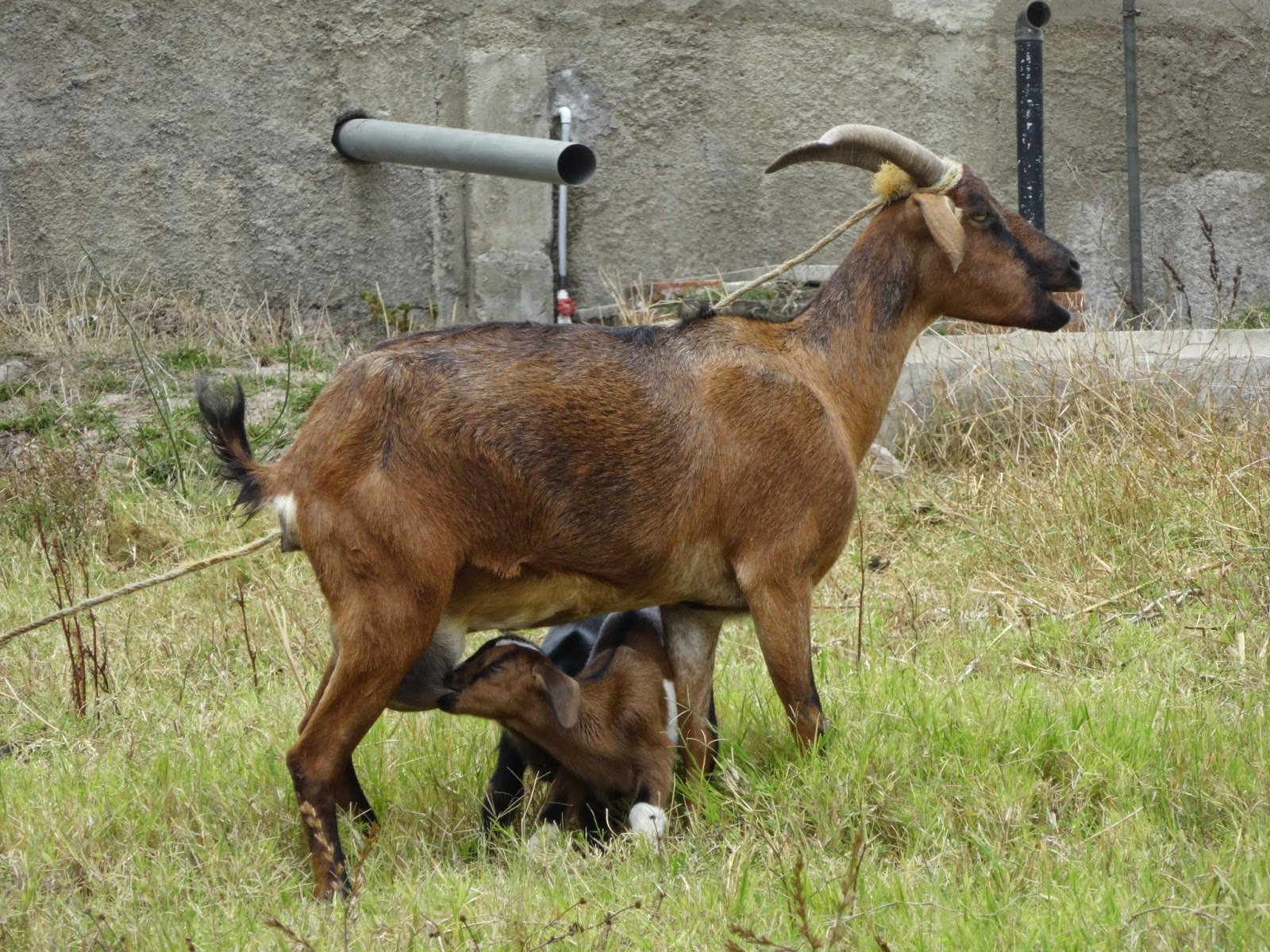
We've been talking about it for a while now, and it is finally happening: we got a goat! Little Cena is only about two months old – he will be of a very tasty age when we serve him up at our going-away party in August. In the mean time, we'll take advantage of having a gigantic yard and no city laws about animal husbandry to learn a few things about castrating, raising and slaughtering our very own goat. Who knows when the next time such a brilliant opportunity might present itself?

How Cena came to land in our particular back yard is a somewhat regretful story. Cena was born in the community of La Garnacha, where we help out on an organic farm one day a week. On just such a day, Cena had gotten out of his pen and happened to wander into the building where we clean vegetables. He hopped around, climbing up on stacks of vegetables and nibbling on carrots, while our coworker Clemente tried to chase him out. After Clemente had chased him out four or five times and Cena had persistently returned for more each time, Davie took Cena in his arms like a baby and carried him back to his owner, Carmelo. On the way to Carmelo's house, Cena fell asleep in Davie's arms.

We had already been thinking about getting a goat for our despedida, and since Cena seemed like about the right age, Davie asked Carmelo if he was for sale. Carmelo offered to sell the goat for 700 cordobas – less than $30 – so we were pretty convinced to go for it. We told Carmelo that we just needed to build a fence around part of our yard and we would buy the goat the following week.

This is where the drama and regret creep in. During that week, as we found out later, Carmelo had sold the goat to his sister, Azucena, who wanted the goat as a pet for her two-year-old daughter. When we showed up on Thursday, Carmelo tried to convince us to buy an older goat instead, but Davie wasn't having any of it. When Azucena found out what had happened, she pulled Davie aside and told him she didn't mind giving up Cena and buying another smaller goat for her daughter. So it was that Cena very narrowly missed out on leading a long, happy life of prancing around a grassy field with a two-year-old; instead, he has ended up in our carnivorous hands.

But although this story will end tragically for Cena, there is redemption. This goat has given us an amazing opportunity to learn, and for that we are very grateful. Here is what I mean.

We've given a lot of thought to what a perfect way this will be to send ourselves off after our two years in Nicaragua. Here in the Nicaraguan campo, raising and slaughtering your own chickens, pigs, cows and goats is pretty par for the course. When little Roberto's second birthday rolls around, his parents are not going to go out and buy a package of hot dogs from the supermarket – no, they're going to go out and kill the chicken that has been running around their yard, laying eggs for them since before Roberto was born. For every special occasion – graduations, birthdays, weddings, funerals – some type of animal is killed to feed the community that comes to pay their respects.

Davie and I admire this culture of eating meat from an animal that you have personally fed and nurtured and then ultimately, an animal that you have looked in the eye and brought yourself to kill. Meat produced like this is not only super-local; it also grants its eater a truer perspective on the full costs of eating meat. Davie and I have both eaten meat all of our lives; now we'll have to come to terms with actually killing the animal that we'll end up eating, and everything that that involves. Since this is a fairly common Nicaraguan practice, we think it will be a fitting challenge for our last few months in Nicaragua. And we will certainly have to depend heavily on our more experienced Nicaraguan friends for advice in every step of the process of preparing Cena for our despedida dinner.

Monday, May 18, 2015

Recipe: Nacatamales

Blog by David

The most important room in a Nicaraguan home is the kitchen. Usually the walls and roof are caked with soot from the wood-fired fogon, which roars with heat while a woman or girl conjures up all the necessary sustenance for her entire family. In a normal day, most Nicaraguans eat rice and beans, or gallo pinto, for breakfast with cuajada (farm cheese) and a tortilla. Lunch is the biggest meal of the day, sometimes featuring a meat dish and always including gallo pinto, a fried plantain and a tortilla. For dinner people often eat leftovers. It may seem that Nicaraguan cooking is somewhat monotonous, but when you look further, it turns out that there is plenty of depth to the Nicaraguan culinary repertoire.

As I am extremely excited about anything to do with cooking, when I heard that the mayor's office was offering a class on Nicaraguan cooking, I signed up immediately at no cost at all. Every Saturday for the past 2 months, I have been getting together with 30 women to learn how to prepare a variety of Nicaraguan entrees, desserts and beverages.

Of course I am the only male pupil – a fact that I emphasize by wearing my pink, polka-dotted apron to class. And I've received an extremely warm welcome in this territory that traditionally does not belong to men. On these Saturday mornings, I've learned all kinds of uses for corn that I didn't even know existed, and I have also shared with these women more efficient ways to prepare food that I learned when I worked at a restaurant in the US.

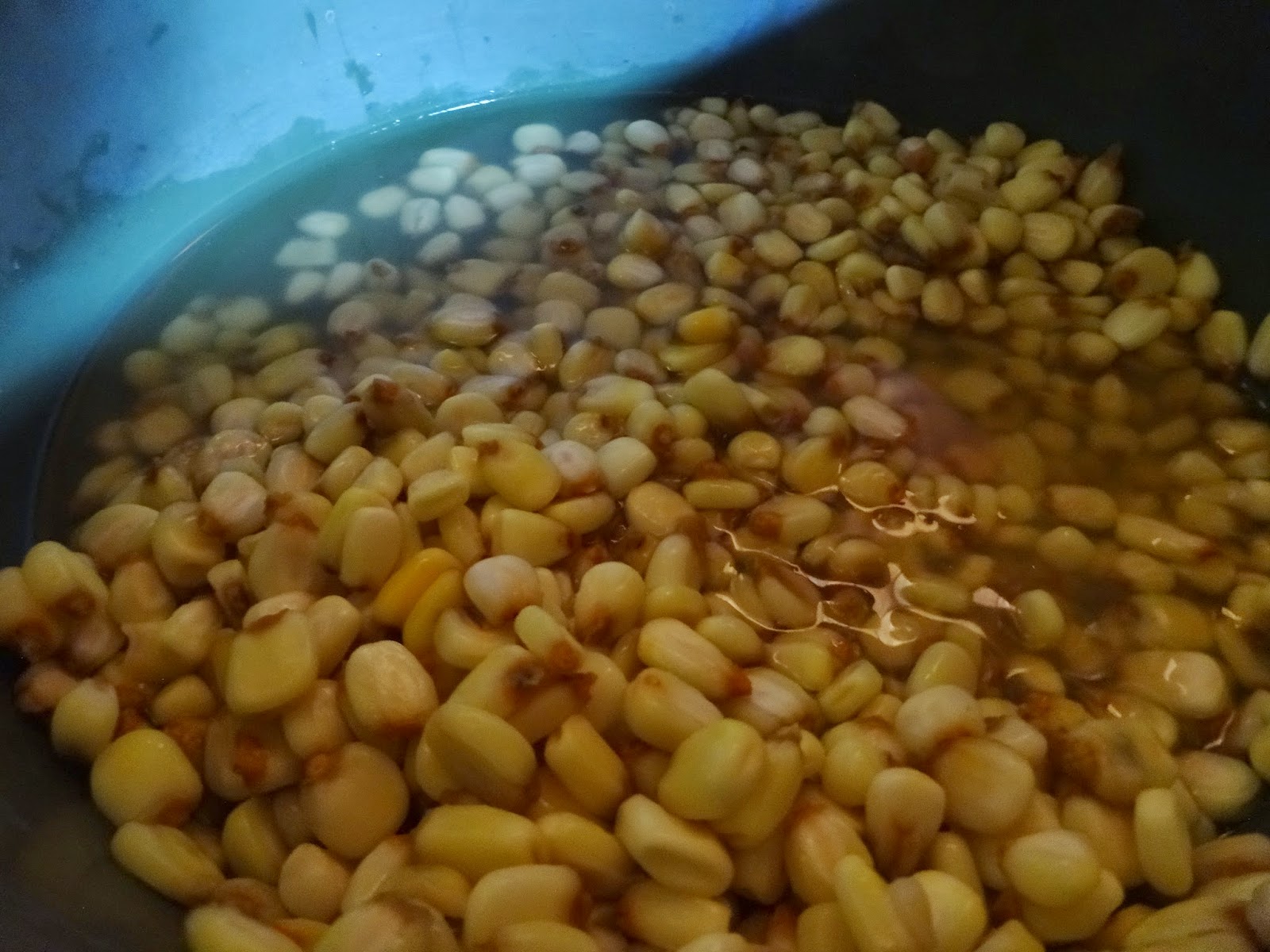
Corn is an amazing food. I have learned how to make main dishes like Indio Viejo, a deliciously thick stew; atol, a sweet pudding; and pinol, a nutritious drink made with corn, cacao and cinnamon. (Nicaraguans are often called pinoleros, i.e. folks that like pinol).

Last week my class made nacatamales, a traditional Nicaraguan food made for special occasions. Everyone, including Sarah and I, loves nacatamales. A nacatamal is a banana leaf pouch that contains corn dough, pork, potatoes, tomatoes, carrots, rice and mint. They look like little green packages ready for a picnic. Early in the morning, we sometimes hear vendors walking through town announcing “Nacatamaaaaaaaaaales.” Hmm...I'm getting hungrier and hungrier as I talk about them. If you are too, try out the following recipe. (Keep in mind that nacatamales are pretty easy to make, though they are somewhat time-consuming.)

Nacatamales


3 lb Maseca
½ lb lard (or butter)
2 lb pork loin, cubed
2 lb beef loin, cubed
2 Tb achiote
¼ cup red wine vinagre
3 lb tomatoes
2 tsp beef bullion
3 lb potatoes
2 large green peppers, sliced
2 lb onions
4 garlic cloves
3 oranges
1 bunch mint
½ L milk
1 cup rice
60 banana leaves
1 bunch twine or food rope (each about 1 m long)

Combine 2 lb of sliced tomatoes, 1 lb of onions, 1 green pepper, the juice of two oranges, 2 Tb achiote, 3 tsp beef bullion and ½ bunch of mint in a blender and blend them all up.

Hand mix the maseca and the water. Once it is thoroughly incorporated, add the blended mixture and place in large pot over high heat. Stir constantly until the mixture thickens enough to create a deliciously thick and moist dough.

While the dough is thickening, have someone slice the leftover potatoes, tomatoes, onions, and carrots. De-leaf the mint stems and set them aside.

To construct your Nacatamal, place two banana leaves on your work table (one as a rectangle and another in a diamond). Place a dollop of the cooked dough in the middle. Place a slice of each of the veggies and mint. Fold up the parallel sides and fold down. Then grab one side and fold towards the middle. Compact the open side, then fold towards the middle. Wrap the twine around the nacatamal like you would tie a gift, creating a cross in the middle, and tie the twine to secure the banana leaf. Place the nacatamal in the large pot of boiling water.

Boil for about 2 hours.

Let cool and serve.

P.S. Sarah and I have been compiling recipes during our time here in Nicaragua, and we are putting them together into a cookbook. We are hoping that by the end of our service term we will have completed it and perhaps can get them printed too. We plan on featuring recipes old and new, east coast and west coast, corn and other ingredients. Let us know if you are interested in buying a copy once we print it.