Monday, April 27, 2015

Help Us Build a School Library in San Nicolas!

Thanks to a generous donation from Akron Mennonite Church, Davie's home church, and donations from various friends and family towards our Balls and Books projects, the San Nicolas high school will soon have its very own mini-library.

A few months ago when we received close to $2000 from Akron Mennonite to spend on sports or books-related projects in San Nicolas, at first we were baffled. With such a large sum of money, any number of things now became possible for the Instituto Publico Carolina Camas Arauz, the only high school in the entire San Nicolas municipality. So we went to Idalia, the principal of the school and our good friend, and asked her what book- or sports-related projects she saw as being most needed.

The list, as we had expected, was long. The school needed world maps, textbooks, sports equipment, uniforms for extracurricular teams, book shelves, books to read for fun, sports lines painted on the court. On and on it went. But what underlay many of these needs was a simpler, if more expensive necessity: space.

The San Nicolas high school, which serves over 400 students from San Nicolas and more than 30 different surrounding communities, has five classrooms (one for each grade of school, from 7th-11th) and one multi-purpose room. This 8 meter by 8 meter room currently serves as the principal's office, teacher's lounge, storage room, library, snack shop, and part-time student hang-out room. Every surface of this room is cluttered with poster paper, volleyballs, stacks of file folders, mops, cans of paint, books and tons of other stuff. In one corner of the room, you can't even turn off the lights without climbing treacherously over a pile of old tents. The condition of this room is so ludicrous that it would be funny if it weren't caused by a serious lack of funding.

So when we talked to Idalia about what we could do with this unexpected gift that had suddenly been dropped in our laps, we decided that we could either buy more stuff to crowd into this room or, with such a generous sum of money, we could build an entirely different room dedicated completely to books. This will be a room where students can go to read for fun during recess or where they can use textbooks to study. It will also be a private space where teachers can go to have private conversations that they don't want students overhearing, or a place for the school counselor to discuss delicate matters with students.

When this room is built, it will also free up a lot of space currently occupied by shelves of textbooks in the multi-purpose principal's office. We hope this will revitalize this room somewhat, making it feel like a more professional environment.

Idalia is spearheading the plans for the mini-library, rallying parents to donate their time to help with the construction to reduce the cost of labor. The Ministry of Education also plans to donate zinc roof panels and the windows and doors for the structure. Idalia hopes to get the project going quite soon so that it will at least be started before we leave in September.

We're excited that we'll be able to leave behind something tangible in San Nicolas, but we also worry that the $2000 or so that we have at our disposal won't quite cover the cost of construction. We've seen many crumbling half-built buildings here in Nicaragua where only enough money was donated by some foreign entity to construct part of the building, after which the project was abandoned. We don't want this to happen. We want to make sure that enough money is available to make this building nice – to make it something that students will use for years to come. If you too feel inspired to make this San Nicolas school library a reality, please consider donating a gift of any size by scrolling down to our VMM profile on this page and clicking the second “donate” button that corresponds to our Balls and Books program. If you have any additional questions about the project, please email us at sarah.f.rich@gmail.com or davidjwiegner@gmail.com.

Thanks again so much to our family and friends who have already donated to this project! We will keep you posted on the progress made in the next few months.

Monday, April 20, 2015

Recipe: Arroz con Leche

Nicaraguan cuisine is not known for its desserts, but there is at least one dessert that Nicaraguans do well: arroz con leche. A few weeks ago, our friend Maria invited us to make arroz con leche at her mother's house in the community of Quebrada de Agua. Made over a fogon, or wood stove, with fresh milk from their family cows, this was probably the best arroz con leche I had ever had. Here is the recipe so you can make it too.

Arroz con Leche


2 pounds rice
½ gallon water
½ tablespoon salt
2 large sticks of cinnamon
½ gallon milk
2 pounds sugar

Break up one cinnamon stick into small pieces and add it to a pot with the rice, salt, and water. Cook the rice in the water over a low flame with the lid on, as you would normally cook rice. Once the rice is cooked through, add half of the sugar and all of the milk. Continue to cook the rice with the lid off so that the liquid gradually thickens. Stir constantly. Cook until you've reached the desired consistency and most of the liquid has been absorbed. Add as much extra sugar as you like and throw in the remaining crushed up cinnamon. Eat the arroz con leche hot or refrigerate it and eat it as a cold pudding.

Tuesday, April 14, 2015

The Many Faces of Machismo

One day a few weeks ago, I was walking with Davie and two other gringas in a rich but vacant Managua neighborhood just after dark, on our way to visit a friend. Behind us we heard the engine of a car accelerating, and the next second, I felt a tremendous blow that left me stumbling off the side of the road. At first I thought I had been hit by the car, but that didn't explain why no one else had been hit or why, when I glanced at the car whizzing off into the night at 40 miles per hour, the man in the passenger seat had his hand extended out of the window. “WHOOP WHOOOOOP!” he whooped.

Davie was the first to understand. “Hijo de puta!” he screamed at the men before the car disappeared. Clutching the burning pain on my bottom, I slowly put it together. The men had sped by within a foot of me, just close enough for the man to extend his hand out the window and slap my bottom. 

Thoughts rushed into my mind and out my mouth in a high-pitched voice that I wished were deeper. “They could have hit me!” I gasped. “If I had stepped just a foot to the left, or if they had swerved a tiny bit, they could have killed me.” But they were gone. They were already gone, flying off whooping stupidly into the night, and I couldn't tell them that they could have killed me. I couldn't tell them how helpless I felt or how the lingering pain in my bottom would make me sick and sad for the next days, bringing on sudden streams of tears that I didn't even know were there. Like an inanimate object, I had received their action, and there was nothing I could do in that moment to act back.

Unfortunately, this kind of sexual harassment is fairly normal in Nicaragua. Like so many other of its Latin American counterparts, Nicaragua is a machista culture, where men are king. This machismo takes all different shapes and forms, subtle and overt, annoying and traumatic, and affects every single Nicaraguan woman. 

When I walk by myself the thirty minutes from the bus station in Esteli to the market downtown, I count the number of times I am catcalled. (It's usually between five and ten). The nice thing about living in a small town like San Nicolas is that the catcalls are much fewer. Maybe because anonymity just doesn't exist, catcalling women is far less a part of the campo culture. (Until, of course, men get drunk.)

In the campo, men have other devices to show women who wields the power. Here in San Nicolas, perhaps the most popular technique is making sure that women basically never leave their houses. One technological development that mysteriously still hasn't made it to the Nicaraguan campo (although cell phones and facebook both have) is locks. Because most people keep all of the money they own in their houses, and because for some reason most houses don't have lockable front doors, someone has to stay home at all times to guard the family possessions. Hint: it is not the men.

No, it is universally known that men must spend their days working in the fields, so the women gracefully take their places in the home, cooking, doing laundry, and most importantly, not interacting with other people. In the Nicaraguan campo, pre-1960s gender roles still reign. We do have some female friends who work outside the home, as teachers or in the ministry of education, but don't think for a minute that their husbands do the cooking or the laundry. What often happens in these situations is, seeing as the wife is at work and the husband – whether or not he has a job – is incapable of domestic labor, their oldest daughter will quit school so she can take care of the housework. And so the cycle continues. 

The other day we were visiting a friend of ours, teaching her how to make peanut butter cookies. When her husband came in from the fields, she dutifully served him his plate of rice and beans for lunch and got back to making cookies. When he was done with his first plate, he asked her to get him some more. By this time she already had cookie dough up to her elbows, and she told him so. “You are worthless,” he said. “I might as well get a robot.” Frankly, I wish he would.

Concurrent with ensuring that your wife never leaves the house is the machista statute that requires that you're never seen in public with your wife or children. It took Davie and I a while to realize that our almost constant companionship around town is an anomaly in San Nicolas. A man seen attending church with his wife or taking his daughter to school is a demonstration of masculine weakness. Instead, men congregate with each other for weekly bro bashes at the baseball stadium. One Sunday I went to a baseball game with Davie and after a quick survey of the stands, realized that of the 80 or so spectators, I was the only woman there. 

Machista law dictates that men use these weekly boy club reunions to get staggeringly drunk. What remains behind closed doors is what happens when these men return, completely sloshed, to their wife and children at home. This is a very private matter, not often spoken of, but our sources tell us that physical abuse of women and children is not uncommon in this part of Nicaragua. 

All of this adds up to a sexist existence that is so depressing, it has taken us a while to know what to do with it. It hurts to see our female friends working so hard, being cheated on by husbands who run off with younger woman, and ultimately embracing the harmful gender role that is the only woman they've ever learned how to be.

We know the impact of our two years in San Nicolas has serious limitations, but we do what we can to change these gender stereotypes. We present ourselves proudly as a couple in public and we invite boys to join our cooking classes and we try to empower our female students. And every once in a while we see a spark of hope in this community – a kind, humble man like our student Bayardo, or the existence of one entire other man in Davie's cooking class, or the fact that the mayor is a woman. 

Or the time, the other day, when I was talking to two kids in our elementary school English class, Andy and Jaraely, who were admiring my glasses. “Did Davie buy you these glasses?” Andy asked me. Jaraely scrunched up her face in disgust, and with a sarcasm that could bend gender, said to Andy, “Oh what, so Davie has to buy Sarah stuff? You think because she's a girl she doesn't have her own money?” That's what gives me hope.

Monday, April 6, 2015

Semana Santa on the Atlantic Coast

Holy Week is arguably the biggest Nicaraguan holiday of the year. During “Semana Santa,” as it's known here, most people have at least a long weekend of vacation, if not the whole week off. As Semana Santa is also the very hottest time of year, the object of the week is to find a cold pool of water to dip your toes in.

In this regard, we went all out. We didn't just buy one of those inflatable kiddie pools that people sell by the sides of the streets at this time of year; we took on the entire Caribbean Sea. With a few of our volunteer friends who work in Managua and Matagalpa, we made the long bus journey across the sparsely-populated Nicaraguan inland, and where the road ended took a boat along the Escondido River to the Atlantic coastal city of Bluefields.

Bluefields – it doesn't sound very Spanish, does it? That's because it's not. The Afro-Caribbean population on the Atlantic Coast actually speaks a Creole English. The complex history of this region makes it feel almost like an entirely different country from the rest of Nicaragua. The Spanish had long since colonized the Pacific side of Nicaragua when, in the mid-19th century, British colonists and their African slaves moved from Jamaica to the Nicaraguan Atlantic Coast. There, the English-speaking Afro-Caribbean people intermarried with the Miskito and Rama indigenous groups that had occupied this territory until then, to produce a richly diverse culture that you won't find anywhere else in Nicaragua.

So Semana Santa was the perfect opportunity for us to get to know this culture and also visit some of the most pristine beaches in Nicaragua. We traveled first to Bluefields by land and then flew to the Corn Islands, two tiny white-sand-and-palm-trees islands in the Caribbean Sea. Of course we did all of the things required when one finds oneself in a tropical island paradise: eat lobster and fish at almost every meal, drink coconut water straight out of the coconut, sunbathe on fine white sand beaches, and swim in the turquoise sea all day long.

This was all amazing. But the part of the Atlantic Coast that impressed me the most was, in the end, not the beaches; it was the people. We arrived in Bluefields on Saturday, and the American priest who we stayed with there invited us to an ecumenical Palm Sunday march through the city the next morning. We were pretty exhausted from our long journey but curious enough about where we were that we decided to get up at 6 a.m. to walk through Bluefields and wave some palm fronds around. We were glad we did.

Gathered in Bluefields' central park to start the march were at least 500 people: people from Catholic churches, people from Baptist churches, people from Moravian and Presbyterian and Lutheran churches. There were English-speaking Creole people, Miskito-speaking indigenous people, and Spanish-speaking Mestizo people. There were people of all shapes and colors. Together, we all marched through the streets of Bluefields, clutching palm fronds and celebrating together this special day in the Christian calendar. We sang songs in Spanish and we sang old hymns in English. Priests and pastors read from the Bible first in Spanish and then in English. It was amazing. No where else in Nicaragua – or maybe even the world – have I encountered such a perfect, peaceful, balancing act of so many different religious beliefs and cultural heritages. (In San Nicolas, the Evangelicals and Catholics, the only two religious groups that really exist, are constantly at each other's throats; nothing like this would ever happen here.)

I have to admit; part of my love affair with the Atlantic Coast was also food-induced. There is a whole different cuisine on this side of Nicaragua, based much more on seafood and coconut than on corn. During our week on the East Coast, I probably ate at least five loaves of coconut bread, a delicious springy yeast bread made with coconut milk. And then there was the pati, a spicy dumpling with a mixture of meat and beans on the inside, and the ginger beer and the “soda cakes,” or ginger cookies. We met a woman one day named Emmalina who explained to us the secrets of making coconut oil. Even the food on the Atlantic Coast reflects the diversity of the area.

I realized that I often still feel like an outsider in San Nicolas. As a gringa, I am certainly an outsider with power and privilege, but that doesn't stop the little kids on the buses from staring at me. So during this holy week, it felt good to be in a place where people are so open, where diversity is the norm, where I fit in because of, rather than in spite of, my difference.  

Monday, March 23, 2015

San Nicolas: a Memoir in Photos

To give you an idea of what normal San Nicolas life is like, we thought we would give you a collection of some of our favorite photos that we've taken in the year and a half we've been in San Nicolas. Enjoy!

On our walk to La Garnacha.

Women travelling to San Nicolas from a far-away community.

A campo sunset.

Davie learns how to milk a cow.

When this fruit farmer comes to the market on Fridays, butts are everywhere.

Getting rides in pick-up trucks!

Jarol shows us his horse's poor dental hygiene.

Little piggies sleeping at the doorstep.

Primary school English class marker tower.

Davie tames a bull to impress our primary school students.

Secondary school class.

Andy made stilts out of old tin cans and walked around town in them.

Washing vegetables, you encounter all kinds of characters.

Birthday party at our student Alondra's house.

Slightly-crowded bus to Esteli. "Dale, dale, dale!"

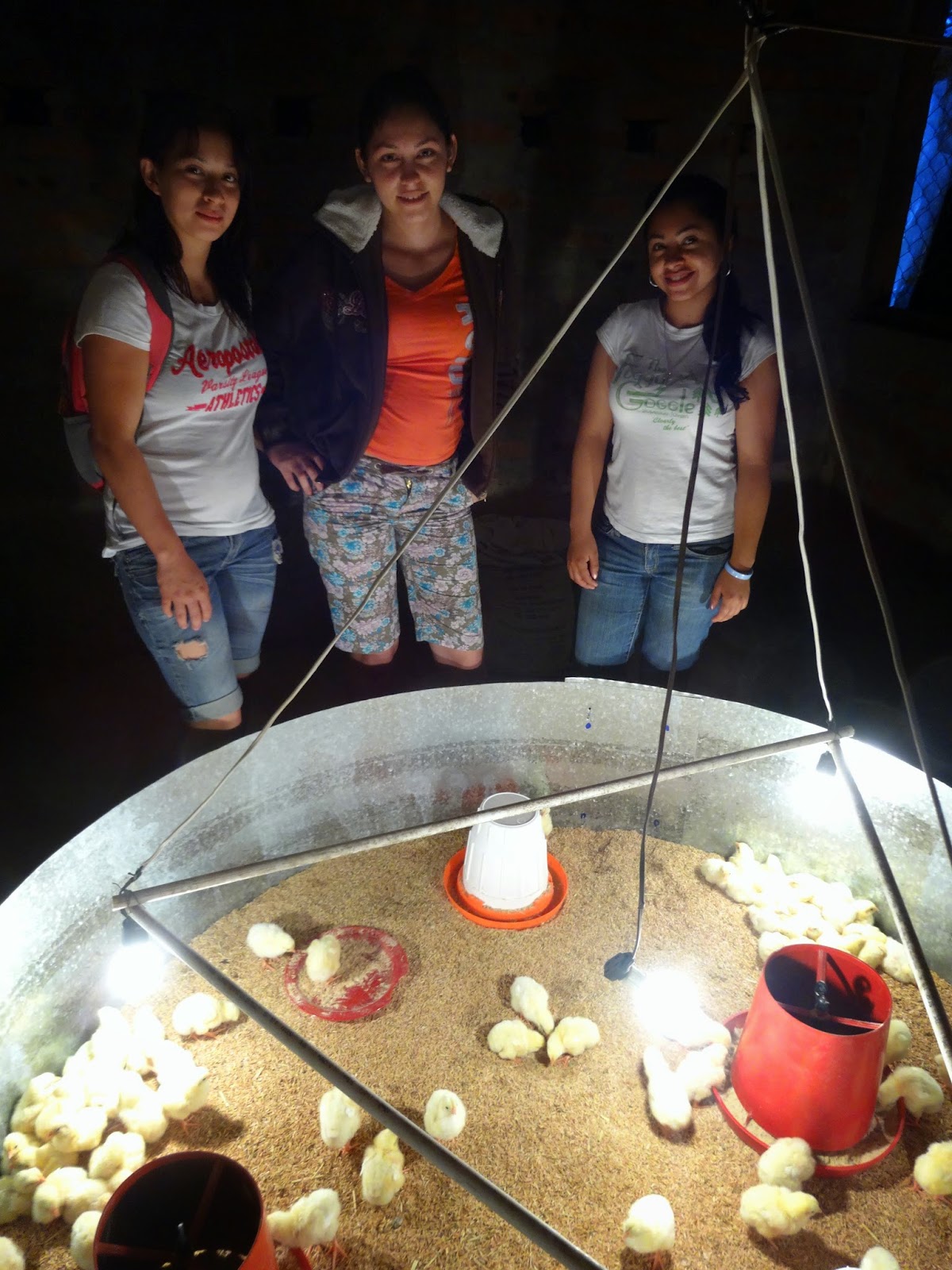
Our friend Fatima's poultry business.

"Made it." (Alcoholism is a huge problem in San Nicolas.)

Descent to San Nicolas, with Volcan Momotombo in the background.

Maylorcito was born the week we got to Nicaragua.

Monday, March 16, 2015

The Nicaraguan Subsistence Farm

Davie and I have been reading Michael Pollen's book The Omnivore's Dilemma recently, and it got us thinking about the stark differences between farms in the US and farms in Nicaragua.

When I think of a farm, I imagine a pastoral scene with chickens and cows and horses and a big red barn and rolling fields stretching towards the horizon growing a whole host of different produce. In his book, Pollen points out that the majority of American farms no longer sustain anywhere near this much diversity; most American farms are gigantic swaths of land that grow one of two crops: corn or soybeans. Diversified family farms, Pollen says, are a thing of the past in the US.

Here in Nicaragua, this is certainly not the case. I can't speak for all parts of Nicaragua, but in our area, farms are only small, family-owned, and diverse. North of Esteli you find big tobacco plantations and south of us there are enormous rice farms, but around San Nicolas these kinds of big-scale farms just don't exist.

Agriculture is definitely the primary industry in this pocket of Nicaragua, but maybe because of the dry, rocky soil or maybe because of the general poverty of the area, small family farms still reign here. Most farms have chickens, pigs, cows, and horses. Farmers grow a whole host of crops on the plots of land that have been in their families' hands for generations: beans, corn, millet, onions, potatoes, and fruit trees. Many of the seeds that they plant have also been in their families for years. Rather than buying sterilized seeds from a big company like Monsanto every year, Nicaraguan farmers just save the beans or corn from their last planting season and plant those seeds again, year after year, passing them down for generations. They call these seeds “criollos.”

In the US's industrial food system, the majority of farmers can't eat what they produce; they sell their corn and soybeans to mills, and their products eventually end up in the hands of big companies who turn the corn and soybeans into processed foods that show up on the shelves of the grocery store. Here, on the other hand, farmers tend to eat only what they produce. Most farmers around here are subsistence farmers; their families eat the corn and beans that they produce and maybe sell some of it locally, but because their leftover disposable income is so small, they can't afford to buy food that they haven't produced. This is, of course, a much healthier and more environmentally sustainable system, but it also leaves these farmers at the whim of nature, with no money saved up as a safeguard against starvation. (See this blog). Neither situation is ideal.

Because of this tradition of subsistence farming, the Nicaraguan diet is based solely on grains and vegetables that farmers grow in Nicaragua. (Processed chips and soft drinks are new in the campo; people still eat very few foods that didn't just come from a plant or animal). For this reason, Nicaragua is still a corn-based culture instead of a wheat-based culture like the US and many European countries.* Nicaraguan breads and cookies are all made out of corn grown on family farms. Early in the morning in San Nicolas, you see little kids carrying big tubs of corn to one of the mills in town so that their families can make tortillas for the day out of corn flour.

It wasn't until recently, in fact, that people around here even started growing vegetables or eating rice. As recently as 30 years ago, people ate only beans, corn tortillas, plantains, eggs, cheese, and maybe the occasional chicken or pork when they killed an animal for a special occasion.

Compared to the crowded feedlots and dirty slaughterhouses in the US that Pollen describes in his book, Nicaraguan animals have it good. Cows graze the rolling hills around San Nicolas and chickens get to run around all day, in and out of people's houses, pen-free. Even in town, lots of people keep chickens and pigs – pigs are always snorting their way up and down the San Nicolas streets. People milk their cows and harvest eggs from their chickens until they're too old, and then they kill them and eat them. I wouldn't say the tough “pollo indio” that comes from these chickens is my favorite kind of meat, but it is certainly efficient, turning laying chickens into meat.

Because of the wholeness of the Nicaraguan diet, it is far easier here to eat in a healthy, sustainable way that doesn't patronize big businesses and processed food that traveled hundred of miles to reach your plate. At the family-owned convenience stores in town (there is no grocery store), we buy “huevos de amor” (literally, “love eggs”), which are eggs laid by chickens in town. In the US, you pay more money for this kind of product; here, huevos de amor are cheaper than the white eggs in a carton that have been transported from far-flung mass farms.

Davie has recently started making his own mozzarella cheese, and we were surprised to discover how easy it is here to find the ingredients to make cheese. Because people here make cheese in their homes every day instead of buying it from a grocery store, you can easily buy rennet tablets at any tiny convenience store for seven cents. Then, Davie goes to our neighbors' and buys a gallon of fresh milk that came from their cows that very morning, and he makes cheese the same day.

In the US, this kind of organic, sustainable food is part of a trendy, expensive, hipstery subculture. Here, eating whole, unprocessed, homemade foods is the norm. I'm not trying to say that this makes Nicaraguans somehow morally superior to US Americans – I know that if Nicaraguans had the money to eat and produce processed foods, they probably would. But it does make me realize how messed up the American food system is, when processed foods that come from far away places are somehow much cheaper than food that is, if labels are to be believed, “organic” and “sustainable.”


*Although, with the advent of processed foods made out of corn, you could easily argue that the US is really a corn-based culture now too.

Monday, March 9, 2015

How to Communicate Like a Nicaraguan

In the hypothetical case that you visit Nicaragua one day and want to pass as an authentic Nicaraguan person (thereby reducing your taxi fares and warranting fewer stares), there are a few things you will need to know about how to communicate with your fellow Nicaraguans.

Nicaraguan Accent

For one thing, cut it out with all those s's on the ends of words! Your Spanish vocabulary needs surgery; take every single word ending in "s" and just sever that little letter off the end. Try it out; isn't "gracia" so much easier than "gracias"?

Secondly, especially if you're in the campo, pretend you have a weird Italian accent. Try singing your sentences instead of saying them. In American English, we end questions by increasing in pitch; in Nicaraguan campo Spanish, the pitch climaxes in the middle of the question and goes down right before the question mark. "Ya te VAS para la casa?" 

Going along with the singsongy lilt, you'll also have to get used to uncomfortable pauses in the middle of words, often after uttering an "a" and before the rest of the word. Thus, the word "agua" becomes "aaa___gua." 

Nicaraguan Slang

Once you have mastered the intricacies of the Nicaraguan accent, you can move on to learning Nicaraguan slang. Here are a few examples - this list is certainly not comprehensive.

B' : Make this strong "b" sound when you are discontented or outraged, or when you want to tell someone, "I told you so!" We hear this one from our students a lot. It comes from "ve," meaning, "see?"

Bolo: Drunk

Boludo: Lazy

Crudo: Hungover ("Crudo" literally means "raw" in Spanish).

Dale pue: All right, sounds good. This is an easy way to end an otherwise awkward conversation that could go on forever. It's really spelled "dale pues," but why even pretend there's an "s" there?

Diakachimba: Nicaraguan hipster for, "awesome!"

Mae: Dude

Ooooo: this high-pitched ooing sound is often the response to a question like, "How long have you lived here?" It means, "I'm not exactly sure, but a long time." 

Que la vaya bien!: One of the most common Nicaraguan phrases, "que la vaya bien" literally means, "that you go well." Say this to people when they're leaving.

Si, mon: Yeah, man.

Tuani: Cool! Davie knew this one as "tuanis" in Costa Rica, but of course, ending s's are not allowed in Nicaragua. 

Va pue: see dale pue. It means basically the same thing and also technically has an "s" on the end.

Nicaraguan Gestures

Finally, and maybe most importantly, study up on your Nicaraguan non-verbals. You see these seƱales everywhere: on the bus, in restaurants, in meetings, between friends. If a Nicaraguan person can avoid talking by using one of these gestures, you can be sure that they most certainly will. Some of them seemed rude to us at first, but don't be offended; they're just another way of expressing something.

Lips pointing: Instead of using a finger to point to something, Nicaraguans point with their lips, puckering them up and sticking them out towards the item in question. This is especially handy if your hands are full or if you don't want to expend too much energy on lifting a finger.


Nose wrinkling: In the US this gesture expresses disgust; in Nicaragua, it communicates the need for clarification. It can mean, for example, "What did you say? I didn't hear you" or "How much does it cost?"


Downward finger snap: This is a hard one to perfect. Holding your middle finger and thumb together, dart your hand down quickly so that your index finger hits the other fingers and make a snapping sound. Use this one when you want to express that something was hard, fast, or intense, or that someone is really strict. 


Hand on hand slide: Place one hand perpendicular to and on top of the other, both palms up, and slide the top hand across the bottom hand. This means, "I'm out of here! It's time to go."

Finger wag: Similar to the reprimanding finger wag we use in the US, the Nicaraguan finger wag moves only the pointer finger back and forth - no other part of the hand should move. Here it is used less to reprimand someone and more as a strong denial or negative answer to a question.


Finger shave: Using the two pointer fingers, hold one steady on the bottom and brush the other one over the bottom finger multiple times. This signifies money and can mean that something is really expensive.


Kissing or rustling mouth noises: You hear this one a lot on the bus, when the bus helper comes around to collect your fare. It can seem quite rude or abrasive at first, but it's meant kindly, as a way of getting your attention.