Monday, March 23, 2015

San Nicolas: a Memoir in Photos

To give you an idea of what normal San Nicolas life is like, we thought we would give you a collection of some of our favorite photos that we've taken in the year and a half we've been in San Nicolas. Enjoy!

On our walk to La Garnacha.

Women travelling to San Nicolas from a far-away community.

A campo sunset.

Davie learns how to milk a cow.

When this fruit farmer comes to the market on Fridays, butts are everywhere.

Getting rides in pick-up trucks!

Jarol shows us his horse's poor dental hygiene.

Little piggies sleeping at the doorstep.

Primary school English class marker tower.

Davie tames a bull to impress our primary school students.

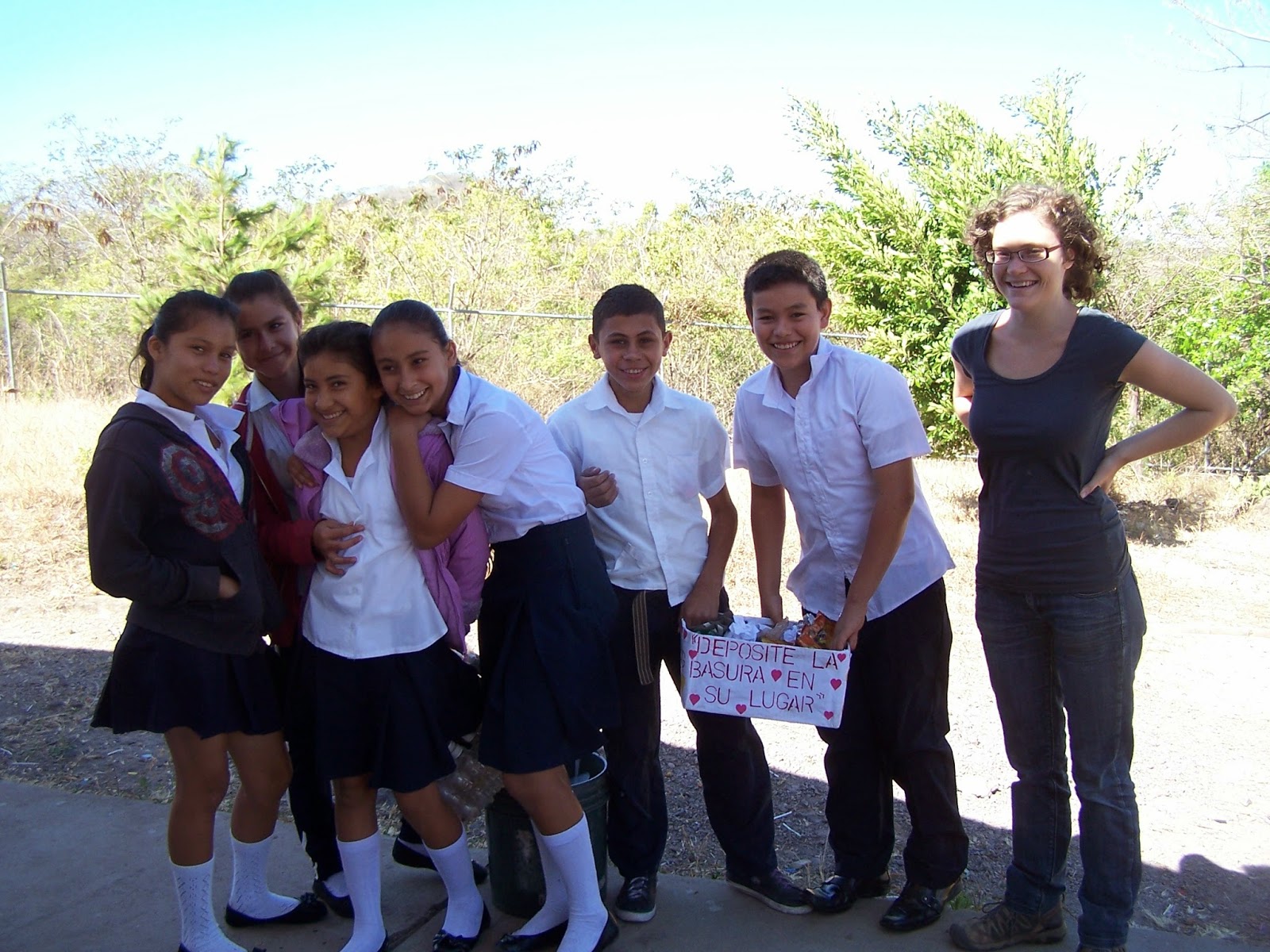
Secondary school class.

Andy made stilts out of old tin cans and walked around town in them.

Washing vegetables, you encounter all kinds of characters.

Birthday party at our student Alondra's house.

Slightly-crowded bus to Esteli. "Dale, dale, dale!"

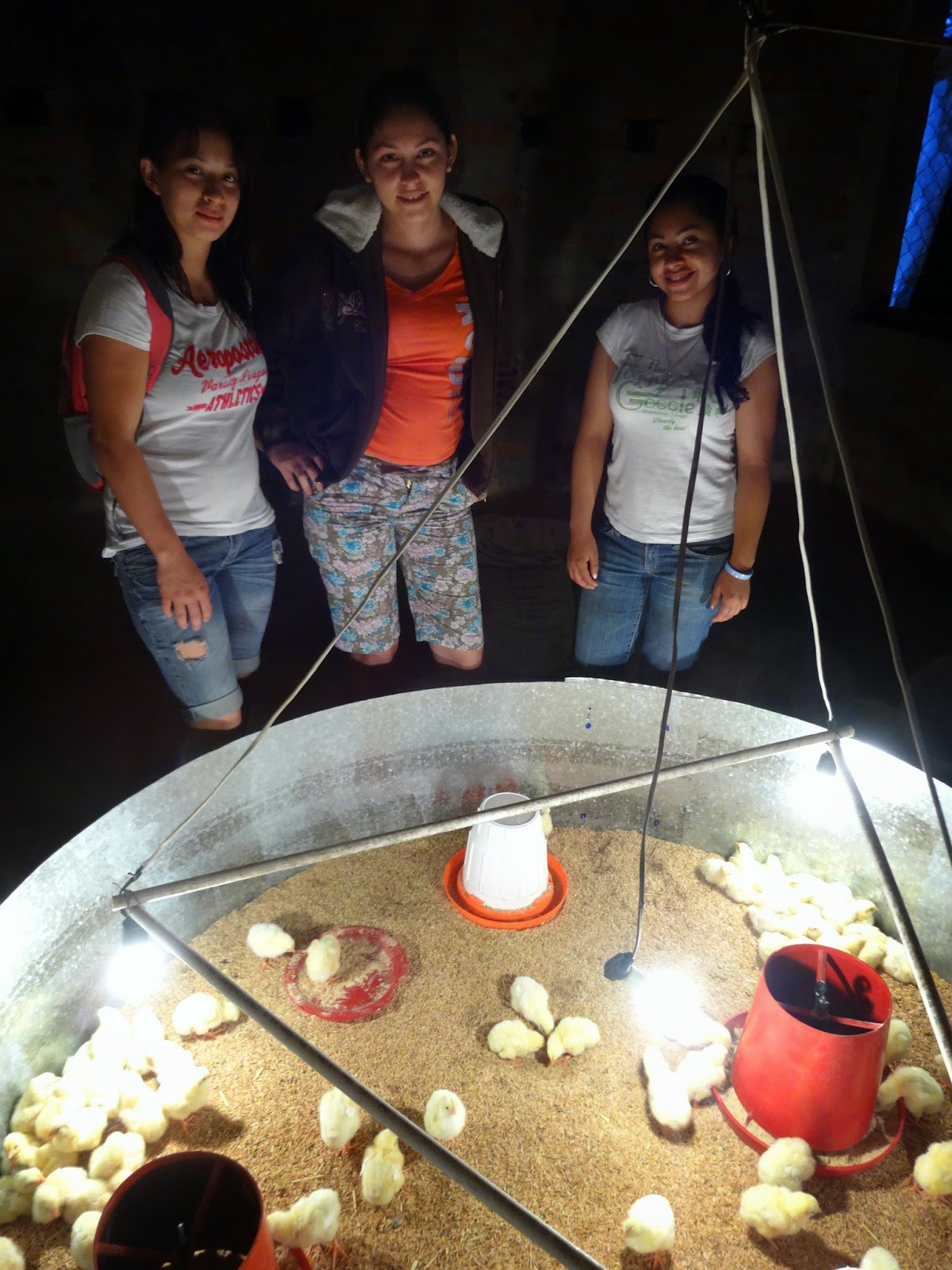
Our friend Fatima's poultry business.

"Made it." (Alcoholism is a huge problem in San Nicolas.)

Descent to San Nicolas, with Volcan Momotombo in the background.

Maylorcito was born the week we got to Nicaragua.

Monday, March 16, 2015

The Nicaraguan Subsistence Farm

Davie and I have been reading Michael Pollen's book The Omnivore's Dilemma recently, and it got us thinking about the stark differences between farms in the US and farms in Nicaragua.

When I think of a farm, I imagine a pastoral scene with chickens and cows and horses and a big red barn and rolling fields stretching towards the horizon growing a whole host of different produce. In his book, Pollen points out that the majority of American farms no longer sustain anywhere near this much diversity; most American farms are gigantic swaths of land that grow one of two crops: corn or soybeans. Diversified family farms, Pollen says, are a thing of the past in the US.

Here in Nicaragua, this is certainly not the case. I can't speak for all parts of Nicaragua, but in our area, farms are only small, family-owned, and diverse. North of Esteli you find big tobacco plantations and south of us there are enormous rice farms, but around San Nicolas these kinds of big-scale farms just don't exist.

Agriculture is definitely the primary industry in this pocket of Nicaragua, but maybe because of the dry, rocky soil or maybe because of the general poverty of the area, small family farms still reign here. Most farms have chickens, pigs, cows, and horses. Farmers grow a whole host of crops on the plots of land that have been in their families' hands for generations: beans, corn, millet, onions, potatoes, and fruit trees. Many of the seeds that they plant have also been in their families for years. Rather than buying sterilized seeds from a big company like Monsanto every year, Nicaraguan farmers just save the beans or corn from their last planting season and plant those seeds again, year after year, passing them down for generations. They call these seeds “criollos.”

In the US's industrial food system, the majority of farmers can't eat what they produce; they sell their corn and soybeans to mills, and their products eventually end up in the hands of big companies who turn the corn and soybeans into processed foods that show up on the shelves of the grocery store. Here, on the other hand, farmers tend to eat only what they produce. Most farmers around here are subsistence farmers; their families eat the corn and beans that they produce and maybe sell some of it locally, but because their leftover disposable income is so small, they can't afford to buy food that they haven't produced. This is, of course, a much healthier and more environmentally sustainable system, but it also leaves these farmers at the whim of nature, with no money saved up as a safeguard against starvation. (See this blog). Neither situation is ideal.

Because of this tradition of subsistence farming, the Nicaraguan diet is based solely on grains and vegetables that farmers grow in Nicaragua. (Processed chips and soft drinks are new in the campo; people still eat very few foods that didn't just come from a plant or animal). For this reason, Nicaragua is still a corn-based culture instead of a wheat-based culture like the US and many European countries.* Nicaraguan breads and cookies are all made out of corn grown on family farms. Early in the morning in San Nicolas, you see little kids carrying big tubs of corn to one of the mills in town so that their families can make tortillas for the day out of corn flour.

It wasn't until recently, in fact, that people around here even started growing vegetables or eating rice. As recently as 30 years ago, people ate only beans, corn tortillas, plantains, eggs, cheese, and maybe the occasional chicken or pork when they killed an animal for a special occasion.

Compared to the crowded feedlots and dirty slaughterhouses in the US that Pollen describes in his book, Nicaraguan animals have it good. Cows graze the rolling hills around San Nicolas and chickens get to run around all day, in and out of people's houses, pen-free. Even in town, lots of people keep chickens and pigs – pigs are always snorting their way up and down the San Nicolas streets. People milk their cows and harvest eggs from their chickens until they're too old, and then they kill them and eat them. I wouldn't say the tough “pollo indio” that comes from these chickens is my favorite kind of meat, but it is certainly efficient, turning laying chickens into meat.

Because of the wholeness of the Nicaraguan diet, it is far easier here to eat in a healthy, sustainable way that doesn't patronize big businesses and processed food that traveled hundred of miles to reach your plate. At the family-owned convenience stores in town (there is no grocery store), we buy “huevos de amor” (literally, “love eggs”), which are eggs laid by chickens in town. In the US, you pay more money for this kind of product; here, huevos de amor are cheaper than the white eggs in a carton that have been transported from far-flung mass farms.

Davie has recently started making his own mozzarella cheese, and we were surprised to discover how easy it is here to find the ingredients to make cheese. Because people here make cheese in their homes every day instead of buying it from a grocery store, you can easily buy rennet tablets at any tiny convenience store for seven cents. Then, Davie goes to our neighbors' and buys a gallon of fresh milk that came from their cows that very morning, and he makes cheese the same day.

In the US, this kind of organic, sustainable food is part of a trendy, expensive, hipstery subculture. Here, eating whole, unprocessed, homemade foods is the norm. I'm not trying to say that this makes Nicaraguans somehow morally superior to US Americans – I know that if Nicaraguans had the money to eat and produce processed foods, they probably would. But it does make me realize how messed up the American food system is, when processed foods that come from far away places are somehow much cheaper than food that is, if labels are to be believed, “organic” and “sustainable.”


*Although, with the advent of processed foods made out of corn, you could easily argue that the US is really a corn-based culture now too.

Monday, March 9, 2015

How to Communicate Like a Nicaraguan

In the hypothetical case that you visit Nicaragua one day and want to pass as an authentic Nicaraguan person (thereby reducing your taxi fares and warranting fewer stares), there are a few things you will need to know about how to communicate with your fellow Nicaraguans.

Nicaraguan Accent

For one thing, cut it out with all those s's on the ends of words! Your Spanish vocabulary needs surgery; take every single word ending in "s" and just sever that little letter off the end. Try it out; isn't "gracia" so much easier than "gracias"?

Secondly, especially if you're in the campo, pretend you have a weird Italian accent. Try singing your sentences instead of saying them. In American English, we end questions by increasing in pitch; in Nicaraguan campo Spanish, the pitch climaxes in the middle of the question and goes down right before the question mark. "Ya te VAS para la casa?" 

Going along with the singsongy lilt, you'll also have to get used to uncomfortable pauses in the middle of words, often after uttering an "a" and before the rest of the word. Thus, the word "agua" becomes "aaa___gua." 

Nicaraguan Slang

Once you have mastered the intricacies of the Nicaraguan accent, you can move on to learning Nicaraguan slang. Here are a few examples - this list is certainly not comprehensive.

B' : Make this strong "b" sound when you are discontented or outraged, or when you want to tell someone, "I told you so!" We hear this one from our students a lot. It comes from "ve," meaning, "see?"

Bolo: Drunk

Boludo: Lazy

Crudo: Hungover ("Crudo" literally means "raw" in Spanish).

Dale pue: All right, sounds good. This is an easy way to end an otherwise awkward conversation that could go on forever. It's really spelled "dale pues," but why even pretend there's an "s" there?

Diakachimba: Nicaraguan hipster for, "awesome!"

Mae: Dude

Ooooo: this high-pitched ooing sound is often the response to a question like, "How long have you lived here?" It means, "I'm not exactly sure, but a long time." 

Que la vaya bien!: One of the most common Nicaraguan phrases, "que la vaya bien" literally means, "that you go well." Say this to people when they're leaving.

Si, mon: Yeah, man.

Tuani: Cool! Davie knew this one as "tuanis" in Costa Rica, but of course, ending s's are not allowed in Nicaragua. 

Va pue: see dale pue. It means basically the same thing and also technically has an "s" on the end.

Nicaraguan Gestures

Finally, and maybe most importantly, study up on your Nicaraguan non-verbals. You see these señales everywhere: on the bus, in restaurants, in meetings, between friends. If a Nicaraguan person can avoid talking by using one of these gestures, you can be sure that they most certainly will. Some of them seemed rude to us at first, but don't be offended; they're just another way of expressing something.

Lips pointing: Instead of using a finger to point to something, Nicaraguans point with their lips, puckering them up and sticking them out towards the item in question. This is especially handy if your hands are full or if you don't want to expend too much energy on lifting a finger.


Nose wrinkling: In the US this gesture expresses disgust; in Nicaragua, it communicates the need for clarification. It can mean, for example, "What did you say? I didn't hear you" or "How much does it cost?"


Downward finger snap: This is a hard one to perfect. Holding your middle finger and thumb together, dart your hand down quickly so that your index finger hits the other fingers and make a snapping sound. Use this one when you want to express that something was hard, fast, or intense, or that someone is really strict. 


Hand on hand slide: Place one hand perpendicular to and on top of the other, both palms up, and slide the top hand across the bottom hand. This means, "I'm out of here! It's time to go."

Finger wag: Similar to the reprimanding finger wag we use in the US, the Nicaraguan finger wag moves only the pointer finger back and forth - no other part of the hand should move. Here it is used less to reprimand someone and more as a strong denial or negative answer to a question.


Finger shave: Using the two pointer fingers, hold one steady on the bottom and brush the other one over the bottom finger multiple times. This signifies money and can mean that something is really expensive.


Kissing or rustling mouth noises: You hear this one a lot on the bus, when the bus helper comes around to collect your fare. It can seem quite rude or abrasive at first, but it's meant kindly, as a way of getting your attention. 

Tuesday, March 3, 2015

Riches in San Nicolas

After two months of living just down the street from us, my family left San Nicolas on the 9:45 bus yesterday morning and will fly back to the US today. They'll be glad to get back to indoor toilets, warm showers, and comfy couches I'm sure, but I don't think they'll forget San Nicolas anytime soon.

To give ourselves a little extra space, my parents and my younger brother Jon rented a house on the edge of town, right next to horse parking lot numero uno (as we call it). They arranged their cheap mattresses on borrowed beds along with a cook stove and some plastic plates in the big front room of the house and quickly settled in to washing clothes by hand and taking cold dump showers. Since they didn't have many pans to cook in, they walked down the street to our house for all lunches and dinners, so we got to see them quite often.

Every morning, they went walking or running in the hills around San Nicolas. (People already thought that as gringos they were weird, they reasoned. Running up steep dirt roads just for the fun of it only confirmed their weirdness.) And after feeding a few scraps of tortilla to a tiny street dog that they named “Paul,” they quickly became Paul's best friends and discovered that Paul's name was actually Nina.

My mom with pine artisans
During the two months that they were here, each of them had their own projects to work on. My dad, a college math professor, spent a lot of time sitting out in their back yard with the poinsettias, thinking about geometry. (His sabbatical project is to write a geometry book). My youngest brother Jon, who is a junior in high school, spent most days working on his home school classes on the internet. (One of which, quite fittingly, was Spanish). And my mom, who has her own fair trade business, sought out local Nicaraguan artisans whose art she could take back to the US to sell.

While she was here, my mom connected with three artists. When my parents visited last year, my mom had bought earrings and headbands from a women's cooperative north of Esteli that makes jewelry out of pine needles. Last weekend, we went to visit them and after watching how they make stuff out of pine, my mom bought more jewelry from them. She also plans to sell wire earrings made by our friend Azucena, who lives in La Garnacha.

Some of our students modeling the headbands
The third Nicaraguan project my mom is working with is one that she started while she was here. When she came in January, she brought down a suitcase full of old t-shirts that people were throwing out, hoping that she could find a woman in San Nicolas who could make braided headbands for my mom to sell in the US. She met Meyling, a local woman who taught me how to do elaborate french braids, when Meyling was over at our house baking bread one day. Meyling (who happened to be my mom's neighbor too), was immediately excited about earning a little extra money by making headbands, and quickly proved to be pretty talented at it too, inventing new styles of braids and knots that no one else could do. So my mom spent lots of time going back and forth between her house and Meyling's, tearing up t-shirts and designing little cloth flowers with Meyling's daughter, Rosaling.

We will definitely miss having my family around; it was great to be able to share our San Nicolas life with them, and even after we go home in September, we will always be able to remember this beautiful place with them.  

Monday, February 23, 2015

Why Learn English?

This week we begin teaching our own after-school English classes for high school, primary school, and adult students. These are all, of course, optional classes in addition to the required high school English classes.

Unlike second language requirements in US high schools, in Nicaragua English is a required class for all 7th through 11th grade students. At the US high school that I went to in Indiana, depending on the diploma you sought, you could get away with taking only two years, or at most three years, of Spanish or French classes. In contrast, Nicaraguans cannot graduate from high school without taking five years of English classes.

It's true that knowledge of English is a pretty crucial skill on a world-wide level, but even as an English teacher myself, I've sometimes wondered why kids in such a remote part of Nicaragua, whose lives are about corralling cattle and harvesting beans, need to know English? English is, after all, only the third most spoken language in the world (after Mandarin and Spanish). And in a town where almost no one speaks passable English, what in the world will these kids do with five years of English lessons under their belts?

One answer, of course, is go to the US, find a job that pays less-than-minimum wages for undocumented immigrants who speak broken English, and spend their lives sending money back to their children in Nicaragua. But the Nicaraguan government can't be training its children in English just so they can leave Nicaragua, can it?

No, especially with the tourist industry growing so rapidly in Nicaragua, there must be a Nicaraguan work sector that requires English. In an effort to incite our students to take learning English seriously (and to figure out why in the world we were teaching them English in the first place), we did some investigating in the city of Esteli, an hour away from San Nicolas.

We went around to various businesses in Esteli that we thought might hire English speakers and talked to the workers who were actually using the English they learned in high school for their jobs. We asked about their wages and their responsibilities and how they used their English, and then we reported back to our students. To give you an idea of how these workers' wages compare to other Nicaraguan wages, the farmers at the agricultural association where we volunteer earn around $110 a month. Teachers at the local public high school earn around $200 a month.

In Esteli we visited Hostal Sonati, a hostel that pays an English-speaking tour guide to show tourists around and do environmental education. We also visited Intur, the government-run tourist agency, where English speakers help put together tourist brochures and literature in English. Both of these tour guides offer a starting salary of around $155 a month.

At Hotel Los Arcos, a nice hotel in Esteli, the receptionist told us that they always have one English speaker to greet guests at the front desk. The receptionist told us that she studied tourism at university and as part of that degree had to take several English classes. A hotel receptionist who speaks English at Los Arcos earns between $190 and $310 a month.

Esteli is known for its tobacco, and we figured that with all the exporting that goes on, the many cigar factories in town must hire English speakers too. At the factory Joya de Nicaragua, we met a young man who spoke almost perfect English. He told us that he studied English intensively for about 2.5 years. At Joya, he deals with international sales and also gives tours to English-speaking visitors. As he was giving us our tour, he threw out English cigar jargon like it was nothing, taking puffs on the huge cigar dangling from his fingers as we went. In such a profitable business, an English speaker like this guy can earn $700 a month.
The man at Joya de Nicaragua also told us that people who speak English and work for a big company have a much better chance of excelling and working their way up the company ladder than people who don't speak English. He said that now is an ideal time to study English, because even though everyone studies English in high school, very few people actually speak it well, so the market is wide open. Right now, it's very easy to find a job for someone who speaks English, and the English job market is only growing. English speakers are needed for all kinds of jobs in the growing tourism industry, and call centers that hire English speakers to troubleshoot over the phone for Americans have recently been introduced in Nicaragua. And now with the Nicaraguan Canal project just on the horizon, for better or worse, Nicaraguans who speak English are becoming invaluable.

All of these jobs, of course, would require our own English students to leave the small town of San Nicolas to find work in a bigger city. And while in some ways it makes me sad to think about some of the brightest San Nicolaseños leaving their beautiful home town to go elsewhere, I think English knowledge can also be a hope for a better life for these students. And this, I hope, is where the value of our English classes lies.  

Monday, February 16, 2015

Back to School

San Nicolas streets in the morning are all of a sudden devoid of bike-riding, marble-playing, errand-running kids; last week, with the start of the 2015 school year, all of these kids were suddenly raptured up to school.

Then again, maybe it didn't really happen all that suddenly. About half of the kids we talked to before school started last Monday proudly reported that they weren't going to go to the first day of school. On the first day of school, they told us, the suckers that do show up just have to clean the entire school. Instead, these conscientious objectors proudly maintained the same positions they had held all summer, in front of their TVs, bored out of their minds.

There are, however, a few benefits to starting school again. For one thing, a new school year means new stuff. When we went to visit our friend Maria the other day, the first thing her eight-year-old daughter, Helen, wanted to do was show us each and every one of her new notebooks, the corners sharp and the pages completely blank. Lots of our students showed up at school last week wearing new uniforms: bright white-collared shirts and ironed navy-blue pants. And then there was the delivery of new textbooks and brooms and soccer balls from the Ministry of Education. So on the whole, kids seem to be excited.

We are certainly glad to see all of our old students again and are excited to get to know the new students in our seventh-grade class. We've put out a sign-up for the after-school English class that we'll hold this year on Mondays and Wednesdays, and almost 30 students have signed up for it already. Right after we put up the sign-up sheet, one girl was signing her name and looking up, asked me, “What is this for?” So we certainly don't expect all 30 of those students to follow through with our class, but at least there is some enthusiasm for it.

This year we're also planning to continue the English class for primary students that we offered last year. And since lots of adults in the community have expressed interest in learning English too, we're going to try doing a class for adults one day a week. At the high school, we'll also continue supporting the Nicaraguan English teacher by helping her during classes.

We have a few non-English-related goals for the school year too. For one thing, we're hoping to develop a library space in the director's office. On several occasions, people have stolen textbooks or money from the school, so with some money we've raised through our Balls and Books fundraiser, we're working on building a wooden bookcase with a lock on it, in which teachers can store textbooks safely. We're also using Balls and Books money to buy some paint to repaint the lines on the basketball court at the school so that P.E. classes can go a little more smoothly. And I'm hoping to host at least one more book club with some of the high school students and have them help me organize a reading program at the elementary school too.

Since Davie and I are leaving in September, we won't be here for the entire 2015 school year. So we hope we can take advantage of the next few months to accomplish some of these goals, teach a little English, and spend as much time with our students as we can.

Monday, February 9, 2015

Ecotourism in Northern Nicaragua

One of the things I have grown to love about Nicaragua is its environmental diversity. Here you find white-sand beaches and steaming volcanoes and enormous lakes, pine forests and cloud forests and thick jungle and mountains, all packed into a tiny country the size of New York state. Tourists are just starting to discover the amazing diversity of this tiny Central American country, and for better or worse, the tourism industry is beginning to seep into the remotest corners of Nicaragua.

We've been doing some touring ourselves for the past week or so, with both sets of our parents and my brother Jon. Most San Nicolaseños don't have the money to see even half of the places we've seen in their own beautiful country. But they do take advantage of the locally-designated tourist sites that they can easily reach on their own two feet. The nearby community of La Garnacha is not much different from any other community around San Nicolas, but because it has worked up an appeal to tourists from outside, San Nicolaseños take pride in it and visit it themselves, taking selfies at the lookout and buying bags of chips at the pulperia in town.

San Nicolas, on the other hand, is in no tourist guide book; it's not a stop on the tourist trail. The only other gringos we ever see in town are Peace Corps gringos. But if you want to visit a remote, mountainous, agricultural area like San Nicolas, there are lots of small ecotourism ventures, both in our area south of Esteli (the Tisey Nature Reserve), and in the Miraflor protected area north of Esteli too. We've spent a lot of time in Tisey and visited Miraflor last week with our parents. Here is why you should visit too.

Tisey Estanzuela Nature Reserve


Before I came here, I never would have believed that there could be pines in such a tropical climate, but in Tisey, they're everywhere. From the overlook at La Garnacha, on a clear day you can look out on the pine-covered mountains in Tisey, all the way to Volcan Momotombo in Lake Managua. There are plenty of hikes to do in this area; take the trail past the La Garnacha overlook to hike to the top of the Cerro Apaguajil, or walk through cow pastures to reach the rock sculptor, Alberto Gutierrez, who carves images on the side of a cliff.

There are a scattering of families and groups who have begun tourism projects in Tisey. We're of course most familiar with La Garnacha, an organic farm, retreat center, and small community in the mountains close to San Nicolas. One family in La Garnacha owns a farm called El Carrizo; they invite tourists to volunteer on their organic farm in exchange for partial room and board. Closer to Esteli is the Ecoposada, a restaurant with lodging that also has a hike up to a beautiful lookout over all of Tisey. And not far outside of Esteli is the Salto Estanzuela, a crashing waterfall above a little pool of water where you can swim.

Miraflor Protected Area


In Miraflor, rolling green hills and fields of potatoes are interspersed with cloud forest, jungle, and enormous trees. Farmers make their living among patches of thick rain forest, home to howler monkeys and trogon birds. There are various communities offering home stays to tourists throughout Miraflor, but we have only visited the highest-elevation level, close to Cebollal. We stayed at Finca Neblina del Bosque in a bamboo cabin overlooking flowers and potato fields. We went on a bird-watching hike one morning and within only a couple hours, had seen 40 different species. At this higher part of Miraflor, you can hike to a giant matapalo tree through the Finca La Soñada or walk through farmland to the waterfall Posa Azul, where you can cool off in the really-cold pool below the falls.

In both Tisey and Miraflor, you'll get a taste of real rural Nicaraguan life. Here, you can learn how to make tortillas or milk cows or just take in the tranquility of these undeveloped natural areas. In the rural hills of Nicaragua, the prime industry since forever has been agriculture, so the people who live here don't have much money. Now small-scale tourism is, for the first time, bringing these families just enough money to improve their standards of living as well as granting them a sense of pride in the beautiful land that is their home.