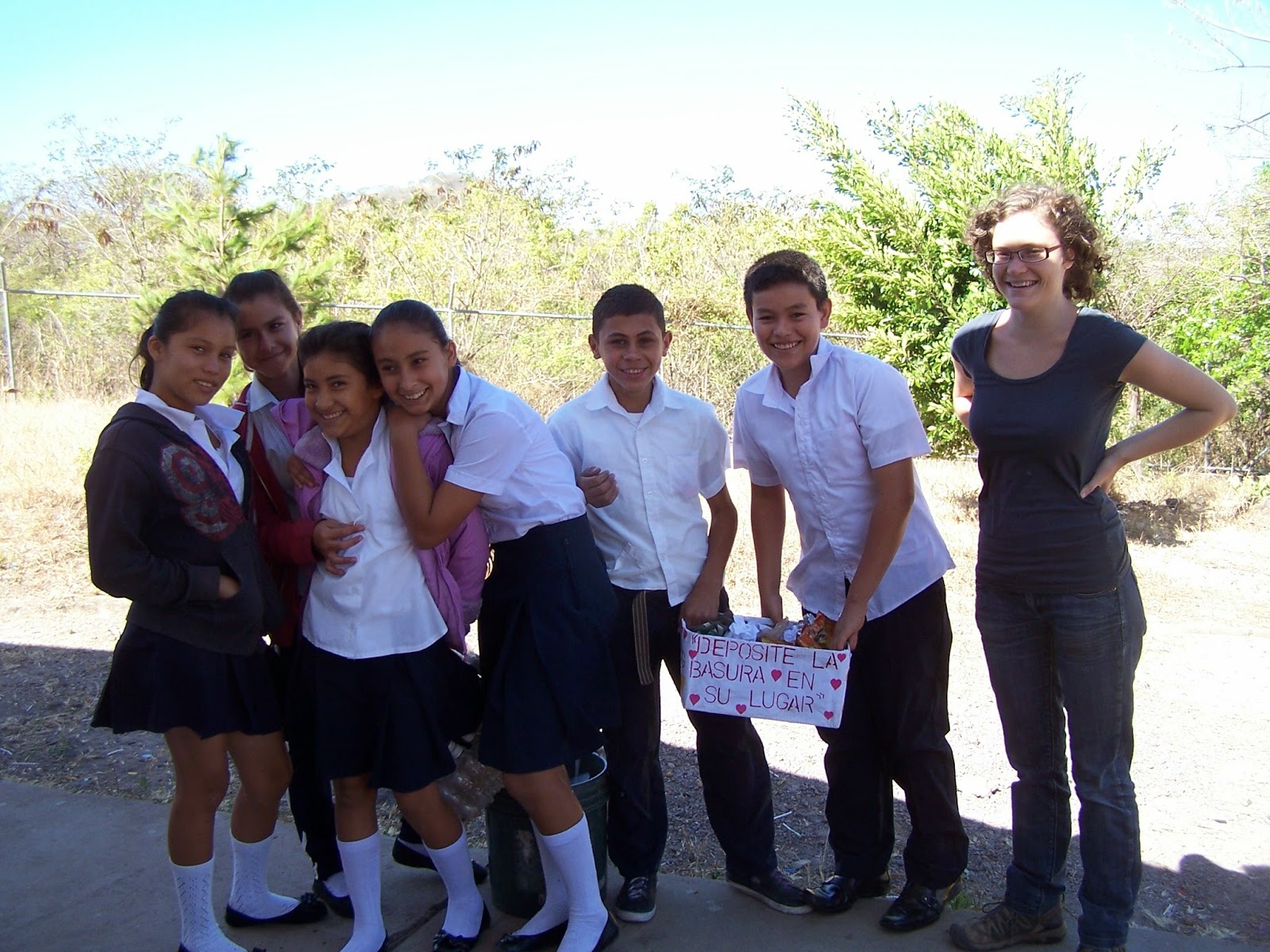
Monday, February 23, 2015

Why Learn English?

This week we begin teaching our own after-school English classes for high school, primary school, and adult students. These are all, of course, optional classes in addition to the required high school English classes.

Unlike second language requirements in US high schools, in Nicaragua English is a required class for all 7th through 11th grade students. At the US high school that I went to in Indiana, depending on the diploma you sought, you could get away with taking only two years, or at most three years, of Spanish or French classes. In contrast, Nicaraguans cannot graduate from high school without taking five years of English classes.

It's true that knowledge of English is a pretty crucial skill on a world-wide level, but even as an English teacher myself, I've sometimes wondered why kids in such a remote part of Nicaragua, whose lives are about corralling cattle and harvesting beans, need to know English? English is, after all, only the third most spoken language in the world (after Mandarin and Spanish). And in a town where almost no one speaks passable English, what in the world will these kids do with five years of English lessons under their belts?

One answer, of course, is go to the US, find a job that pays less-than-minimum wages for undocumented immigrants who speak broken English, and spend their lives sending money back to their children in Nicaragua. But the Nicaraguan government can't be training its children in English just so they can leave Nicaragua, can it?

No, especially with the tourist industry growing so rapidly in Nicaragua, there must be a Nicaraguan work sector that requires English. In an effort to incite our students to take learning English seriously (and to figure out why in the world we were teaching them English in the first place), we did some investigating in the city of Esteli, an hour away from San Nicolas.

We went around to various businesses in Esteli that we thought might hire English speakers and talked to the workers who were actually using the English they learned in high school for their jobs. We asked about their wages and their responsibilities and how they used their English, and then we reported back to our students. To give you an idea of how these workers' wages compare to other Nicaraguan wages, the farmers at the agricultural association where we volunteer earn around $110 a month. Teachers at the local public high school earn around $200 a month.

In Esteli we visited Hostal Sonati, a hostel that pays an English-speaking tour guide to show tourists around and do environmental education. We also visited Intur, the government-run tourist agency, where English speakers help put together tourist brochures and literature in English. Both of these tour guides offer a starting salary of around $155 a month.

At Hotel Los Arcos, a nice hotel in Esteli, the receptionist told us that they always have one English speaker to greet guests at the front desk. The receptionist told us that she studied tourism at university and as part of that degree had to take several English classes. A hotel receptionist who speaks English at Los Arcos earns between $190 and $310 a month.

Esteli is known for its tobacco, and we figured that with all the exporting that goes on, the many cigar factories in town must hire English speakers too. At the factory Joya de Nicaragua, we met a young man who spoke almost perfect English. He told us that he studied English intensively for about 2.5 years. At Joya, he deals with international sales and also gives tours to English-speaking visitors. As he was giving us our tour, he threw out English cigar jargon like it was nothing, taking puffs on the huge cigar dangling from his fingers as we went. In such a profitable business, an English speaker like this guy can earn $700 a month.

The man at Joya de Nicaragua also told us that people who speak English and work for a big company have a much better chance of excelling and working their way up the company ladder than people who don't speak English. He said that now is an ideal time to study English, because even though everyone studies English in high school, very few people actually speak it well, so the market is wide open. Right now, it's very easy to find a job for someone who speaks English, and the English job market is only growing. English speakers are needed for all kinds of jobs in the growing tourism industry, and call centers that hire English speakers to troubleshoot over the phone for Americans have recently been introduced in Nicaragua. And now with the Nicaraguan Canal project just on the horizon, for better or worse, Nicaraguans who speak English are becoming invaluable.

All of these jobs, of course, would require our own English students to leave the small town of San Nicolas to find work in a bigger city. And while in some ways it makes me sad to think about some of the brightest San Nicolaseños leaving their beautiful home town to go elsewhere, I think English knowledge can also be a hope for a better life for these students. And this, I hope, is where the value of our English classes lies.  

Monday, February 16, 2015

Back to School

San Nicolas streets in the morning are all of a sudden devoid of bike-riding, marble-playing, errand-running kids; last week, with the start of the 2015 school year, all of these kids were suddenly raptured up to school.

Then again, maybe it didn't really happen all that suddenly. About half of the kids we talked to before school started last Monday proudly reported that they weren't going to go to the first day of school. On the first day of school, they told us, the suckers that do show up just have to clean the entire school. Instead, these conscientious objectors proudly maintained the same positions they had held all summer, in front of their TVs, bored out of their minds.

There are, however, a few benefits to starting school again. For one thing, a new school year means new stuff. When we went to visit our friend Maria the other day, the first thing her eight-year-old daughter, Helen, wanted to do was show us each and every one of her new notebooks, the corners sharp and the pages completely blank. Lots of our students showed up at school last week wearing new uniforms: bright white-collared shirts and ironed navy-blue pants. And then there was the delivery of new textbooks and brooms and soccer balls from the Ministry of Education. So on the whole, kids seem to be excited.

We are certainly glad to see all of our old students again and are excited to get to know the new students in our seventh-grade class. We've put out a sign-up for the after-school English class that we'll hold this year on Mondays and Wednesdays, and almost 30 students have signed up for it already. Right after we put up the sign-up sheet, one girl was signing her name and looking up, asked me, “What is this for?” So we certainly don't expect all 30 of those students to follow through with our class, but at least there is some enthusiasm for it.

This year we're also planning to continue the English class for primary students that we offered last year. And since lots of adults in the community have expressed interest in learning English too, we're going to try doing a class for adults one day a week. At the high school, we'll also continue supporting the Nicaraguan English teacher by helping her during classes.

We have a few non-English-related goals for the school year too. For one thing, we're hoping to develop a library space in the director's office. On several occasions, people have stolen textbooks or money from the school, so with some money we've raised through our Balls and Books fundraiser, we're working on building a wooden bookcase with a lock on it, in which teachers can store textbooks safely. We're also using Balls and Books money to buy some paint to repaint the lines on the basketball court at the school so that P.E. classes can go a little more smoothly. And I'm hoping to host at least one more book club with some of the high school students and have them help me organize a reading program at the elementary school too.

Since Davie and I are leaving in September, we won't be here for the entire 2015 school year. So we hope we can take advantage of the next few months to accomplish some of these goals, teach a little English, and spend as much time with our students as we can.

Monday, February 9, 2015

Ecotourism in Northern Nicaragua

One of the things I have grown to love about Nicaragua is its environmental diversity. Here you find white-sand beaches and steaming volcanoes and enormous lakes, pine forests and cloud forests and thick jungle and mountains, all packed into a tiny country the size of New York state. Tourists are just starting to discover the amazing diversity of this tiny Central American country, and for better or worse, the tourism industry is beginning to seep into the remotest corners of Nicaragua.

We've been doing some touring ourselves for the past week or so, with both sets of our parents and my brother Jon. Most San Nicolaseños don't have the money to see even half of the places we've seen in their own beautiful country. But they do take advantage of the locally-designated tourist sites that they can easily reach on their own two feet. The nearby community of La Garnacha is not much different from any other community around San Nicolas, but because it has worked up an appeal to tourists from outside, San Nicolaseños take pride in it and visit it themselves, taking selfies at the lookout and buying bags of chips at the pulperia in town.

San Nicolas, on the other hand, is in no tourist guide book; it's not a stop on the tourist trail. The only other gringos we ever see in town are Peace Corps gringos. But if you want to visit a remote, mountainous, agricultural area like San Nicolas, there are lots of small ecotourism ventures, both in our area south of Esteli (the Tisey Nature Reserve), and in the Miraflor protected area north of Esteli too. We've spent a lot of time in Tisey and visited Miraflor last week with our parents. Here is why you should visit too.

Tisey Estanzuela Nature Reserve


Before I came here, I never would have believed that there could be pines in such a tropical climate, but in Tisey, they're everywhere. From the overlook at La Garnacha, on a clear day you can look out on the pine-covered mountains in Tisey, all the way to Volcan Momotombo in Lake Managua. There are plenty of hikes to do in this area; take the trail past the La Garnacha overlook to hike to the top of the Cerro Apaguajil, or walk through cow pastures to reach the rock sculptor, Alberto Gutierrez, who carves images on the side of a cliff.

There are a scattering of families and groups who have begun tourism projects in Tisey. We're of course most familiar with La Garnacha, an organic farm, retreat center, and small community in the mountains close to San Nicolas. One family in La Garnacha owns a farm called El Carrizo; they invite tourists to volunteer on their organic farm in exchange for partial room and board. Closer to Esteli is the Ecoposada, a restaurant with lodging that also has a hike up to a beautiful lookout over all of Tisey. And not far outside of Esteli is the Salto Estanzuela, a crashing waterfall above a little pool of water where you can swim.

Miraflor Protected Area


In Miraflor, rolling green hills and fields of potatoes are interspersed with cloud forest, jungle, and enormous trees. Farmers make their living among patches of thick rain forest, home to howler monkeys and trogon birds. There are various communities offering home stays to tourists throughout Miraflor, but we have only visited the highest-elevation level, close to Cebollal. We stayed at Finca Neblina del Bosque in a bamboo cabin overlooking flowers and potato fields. We went on a bird-watching hike one morning and within only a couple hours, had seen 40 different species. At this higher part of Miraflor, you can hike to a giant matapalo tree through the Finca La Soñada or walk through farmland to the waterfall Posa Azul, where you can cool off in the really-cold pool below the falls.

In both Tisey and Miraflor, you'll get a taste of real rural Nicaraguan life. Here, you can learn how to make tortillas or milk cows or just take in the tranquility of these undeveloped natural areas. In the rural hills of Nicaragua, the prime industry since forever has been agriculture, so the people who live here don't have much money. Now small-scale tourism is, for the first time, bringing these families just enough money to improve their standards of living as well as granting them a sense of pride in the beautiful land that is their home. 

Tuesday, January 27, 2015

VMM Retreat 2015

This past week we met in the shadow of Volcan Mombacho with five other volunteers, for Volunteer Missionary Movement (VMM)'s annual retreat. VMM-USA is a small organization, but its volunteers stationed in Nicaragua, El Salvador, and Guatemala are doing a lot of valuable work in Central America.

Throughout the week, we played innumerable games of Dutch Blitz, hiked around the crater of Volcan Mombacho, watched the stars from a roof-top terrace, ate four bags of chocolate, and reflected on the personal and social transformations inspired by our service in various workshops. We also got the chance to meet Father Fernando Cardenal, the famous Nicaraguan priest who ran the hugely impactful Nicaraguan literacy campaign in the early 1980s. Cardenal told us stories about the unifying force the literacy campaign had on Nicaraguans and spoke to us about our obligation to act to combat the systems of poverty and marginalization that dominate our world. This mandate is, of course, the mission that all of our fellow VMM volunteers work for in various ways in their various Central American countries. Here is how they do this.

Kelsey and Erika, Centro Cultural Batahola Norte, Managua, Nicaragua


Kelsey and Erika live across the street from the cultural center where they work in the poor Managua neighborhood of Batahola Norte. The center trains people from the neighborhood in English, computers, natural medicine, cooking, and various other things, as well as offering programs in violence prevention, singing and dancing groups, environmental issues, and lots of other cool things. Kelsey and Erika teach English and are involved in several other programs that the center offers. Recently, they've raised enough money through their home churches to be able to take a group of inner-city Managua kids out to the Bosawas nature reserve, where they'll learn about environmentalism and preserving this ecologically important rainforest. Kelsey and Erika also seem to know almost every person in their neighborhood; they often sit out on their front porch, greeting and chatting with people who pass by.

Like us, Kelsey and Erika are currently looking for two new volunteers to continue their work at the Batahola cultural center when they leave this September. If you or anyone you know might be interested in this great position, you can find more information about the job on their blog: https://bataholavolunteers.wordpress.com/apply/

Claire and Julie, SHARE, San Salvador, El Salvador


Claire and Julie started working at SHARE, an organization that promotes human rights and social justice in El Salvador, this past summer. El Salvador is a very difficult and dangerous place to live right now; Claire and Julie told us that drug-related gang violence in El Salvador currently kills an average of 17 people per day. And yet they bravely continue their work to promote life and growth in El Salvador. Julie coordinates, translates for, and leads delegations from the US that come down to support SHARE's work and learn about the situation and people of El Salvador. Claire writes articles for SHARE's publications and often attends rallies and marches for justice in San Salvador. You can learn more about SHARE on its website: http://www.share-elsalvador.org/

Pieter, CAPAZ, Quetzaltanango, Guatemala


Pieter is a gregarious Dutchman who has worked in Guatemala for 20+ years. He lives in Chiapas, Mexico with his family (including grandchildren), and makes a 6-hour commute to work in Guatemala every few days. Pieter is especially cool because he actually founded the organization CAPAZ. He helps educate indigenous Mayan farmers, most of whom are women, about how to properly raise and care for their animals – an effort that improves both their income and their diet. CAPAZ also teaches classes on alternative energy systems. Here is CAPAZ's website: http://www.fundacioncapaz.org/en/

Monday, January 19, 2015

How to: Hand-wash your Clothes, Nicaraguan Style

Every few days, we join thousands of Nicaraguans and women all over the developing world in the painstaking process of washing our clothes by hand. I once heard someone claim that the invention of the washing machine single-handedly liberated women to work outside the home, and I believe it. Especially if you have a flock of 10 or so children like so many women here traditionally do, washing clothes for the whole family takes a looooooong time. Add to the daily chores of making tortillas, cleaning the floor, and taking care of little kids (jobs that men are constitutionally incapable of performing) four hours every day or two of scrubbing the daily dirt from your kids' clothes, and there aren't many more hours left in the day.

Unfortunately, the washing machine hasn't made it to rural Nicaragua yet, so women still wake up at ungodly hours (4 or 5 a.m. usually) to accomplish everything they're obliged to accomplish in a day. We're only two people, so Davie and I do the laundry once a week, alternating who does it each week. We try to wear our clothes as long as we can before washing them, but even so, a load of laundry takes us an intensive 3ish hours to wash by hand. Most Nicaraguan women wash clothes twice a week or so, waking up before the sun is up to do laundry so that the clothes have all day to dry in the sun.

I don't even scrub my clothes as hard as most Nicaraguan women do, but after every load of laundry I feel completely exhausted, like I've been in a 3-hour tug-of-war contest. My hands feel tingly and raw for the next day or so, and my arm muscles ache. I suppose this explains why even older Nicaraguan women are still amazingly strong. This intense scrubbing also takes a decided toll on the clothes; most of Davie's t-shirts have baseball-sized holes in the armpits, and all the jeans I brought to Nicaragua a little over a year ago have fallen apart already.

The only break women get in all this is when it comes to underwear. The aura of privacy surrounding a person's underclothes forces men and children to wash their own damn undies – a task that they do in the shower. Everything else – clothes, sheets, towels, rags – the women wash. We get especially nostalgic about washing machines when we have to wash either jeans (which are really hard to wring out) or sheets (which are just way too hefty for the area of the pila, or washing sink).

We just wash our clothes in the pila in our back yard, next to the grove of banana trees, but we've seen all manner of laundry-doing landscapes. Women in the country often wash their clothes in a river or stream near their house or lug all of their dirty clothes to their water source, which could be a natural spring or a well half a mile or so from their house. When we were on the Isla de Ometepe, we discovered a pila strategically placed waste-deep in the Lago Nicaragua, where women could do their laundry with the best views of the lake and surrounding volcanoes.

In Spanish, the word for “washing machine” and “person who does the laundry” is the same: lavadora. The only person we know of in San Nicolas who has an actual machine, however, is Idalia, our school principal. But even Idalia hardly ever uses her washing machine; she claims that the machine just doesn't clean clothes as thoroughly as a good hand washing. We're skeptical. But in case you want to test out Idalia's theory, join us and many many Nicaraguan women in washing your clothes by hand this week! Here's how.

What You Need:

2 large buckets
A pila, or a ribbed surface. If you don't have anything like this, you can use a piece of rough cement or rock.
Enough water to fill both buckets 2/3 of the way
Laundry detergent – the powder kind
Laundry soap – a solid bar of soap
A piece of string to hang up as a clothesline
Clothespins
Dirty clothes

How to Wash Your Clothes by Hand, Nicaraguan Style:


  1. Fill both buckets with water, dumping a half-cup of powdered detergent into the wash bucket and reserving the other bucket for rinsing.
  2. Dump all of your dirty clothes into the wash bucket and soak them for at least 30 minutes in the soapy water. In the mean time, clean off your pila or washing area; it is possible for clothes to become more dirty in the process of cleaning them if you don't do this.
  3. After the clothes have soaked for a while, you can start washing. Take one item of clothes from the wash bucket. Wring it out a little, but leave enough water in it for it to get a little sudsy. Rub the soap bar on it, particularly on parts that are stained or especially stinky, like the armpits or collar. Soaped side down, scrub the cloth across the ribbed or rough pila thoroughly. (Nicaraguan women get especially ferocious with the cloth at this point). When you've done this to all the important parts (sometimes front and back is necessary), wring it out thoroughly to try to get all the soap out. Then drop it in the rinse bucket.
  4. Repeat step 3 with all of the clothes in the wash bucket. I usually save underwear and socks for last so they get a good full soak.
  5. Once you've washed all the clothes, you still need to wring them out. This part is deceptively important – if you don't wring your clothes out really well, they will take too long to dry and will start smelling like old wet washcloths. It's all in the wrists.
  6. When all of the clothes are wrung dry, hang them up on the the clothesline; barbed wire is a popular clothesline around here. Try to hang them so that the clothes overlap as little as possible so they'll dry quickly. We're in the dry season now, so the wind usually dries clothes within a few hours, but in the rainy season it sometimes took three days to dry a pair of jeans.
    When all is said and done, your clothes won't have the nice soft, warm feeling of clothes emerging from a dryer, but you will be able to brag that they were all washed with no other power than your own.

Monday, January 12, 2015

Recipe: Indio Viejo

We were first introduced to the dish Indio Viejo, or "old Indian," when Idalia, the principal of the high school, made it for a school food fair last year. Since then, we've tried to eat it every chance we get. It might seem bold to claim this for a dish that's really just a mush of various ingredients, but I think it's true; Indio Viejo is my favorite Nicaraguan food.

Yesterday, in honor of my mom and brother being in town, we convinced Idalia to teach us how to make this mysteriously delicious mush. We're still not sure where the strange name comes from, but Idalia told us that Indio Viejo is a uniquely Nicaraguan dish that people have been making since before the Spanish set foot in Nicaragua. I think it's also a dish that is fairly easy to make with ingredients you can find in the US, so give it a try!

Indio Viejo

2 lbs of chicken
1 lb of beef
1/2 lb of pork
broth from the meat
1 onion, diced
2 small green peppers, diced
4 sprigs of mint
4 sprigs of parsley
A small handful of cilantro
1 teaspoon of fresh oregano
3 cloves of garlic, diced
2 - 2.5 cups of masa, or corn flour. Usually you can find Maseca in Hispanic grocery stores in the US.
1 tablespoon of achiote, or more depending on desired color and flavor. If you can't find achiote, you can use a little bit of chili powder.
1 orange, juice only
*extra chopped mint and cilantro for garnish*

Boil the meat in enough water to submerge all of it for an hour to an hour and a half, or until it's soft enough to shred. Save the broth and shred all of the meat together in a bowl.

In a blender, blend the onion, green pepper, mint, parsley, cilantro, oregano, and garlic with enough broth to cover all of the vegetables and herbs, to make a thick liquid.

In a large sauce pan, melt 1-2 tablespoons of butter or margarine and add the shredded meat. Heat until sizzling, and then add the blended herb mixture. Cook until heated through.

Combine 3 cups of broth with the masa in a medium bowl. Dissolve the masa completely and add achiote and orange juice.  Once it is nicely combine add to the meat mixture.  Stir constantly for about 5 mins, until mixture gets thick.

Serve with rice, fried plantains, a dollop of beans, and a fresh corn tortilla.

Enjoy!

Sunday, January 4, 2015

Feliz Año Nuevo!

We've been off the grid for a few weeks, traveling around Nicaragua with visitors. Over Christmas and New Years, we got to visit some of our favorite places (Ometepe, Granada, Laguna de Apoyo) with some of our favorite people (our friends Remy and Gwyn and Davie's sister Anna and her family).

We began 2015 on the roof-top balcony of our hotel in Granada, with a 360-degree view of all of the fireworks shows going off all over Granada. Fireworks went off in every direction – from the cathedral in the central park, from the lake side, from the courtyards of colonial houses across the city. By 12:10, the night sky was just one huge cloud of smoke. And by the next afternoon, the drunks were still passed out in the cobblestone streets.

Thus began our last year living in Nicaragua. Looking back at our list of New Year's resolutions from last year, it looks like we accomplished quite a few of our goals for 2014:

- Start an after-school book club of some sort
- Plant and grow a garden in our back yard
- Hike to Cerro Apaguaji, a scenic mountain that overlooks the lands southwest of San Nicolas
- Visit a women's cooperative in Potrerillos that makes jams
- Continue our cooking club with neighborhood kids
- Work with the P.E. teacher, Reynaldo, to develop some after-school sports teams
- Fix the leaks in our roof
- Learn how to do the elaborate braids that so many little girls have
- Continue tutoring adults in the community in English
- Spruce up the natural medicine area in front of our house
- Help La Garnacha, the local organic farm, improve their communications materials
- Get bikes
- Visit Costa Rica and Davie's friends there
- Finish the Game of Thrones book series
- Teach English to a class of little kids and a class of high school students
- Bake stuff (including sourdough bread)
- Visit the Isla de Ometepe in the middle of Lake Nicaragua
- Practice my Spanish with our friend Fatima, who works at the pharmacy next door
- Deepen our friendships with the people of San Nicolas

And here are some things that we still want to do in 2015 before we leave Nicaragua:

- Visit the huge Bosawas nature reserve in northern Nicaragua
- Teach computer classes to high school teachers
- Form a women's baking group
- Go on a tour of the famous Nicaraguan Flor de Caña rum factory
- Learn how to make nacatamales
- Ride horses
- Go over land to Bluefields on the Atlantic Coast
- Do origami with some of our little kid friends
- Organize or participate in a community trash pick-up day
- Learn more about the 1980s Contra war in this area through oral histories

To top off our streak of visitors, my (Sarah's) parents and brother, Jon, arrived in Nicaragua a few days ago and will be staying in San Nicolas for two months. They are renting a house just down the street from us. My dad will work on writing a book for his sabbatical while my mom connects with some local artists and Jon homeschools. We're really excited for them to get to know our friends here and come to love San Nicolas as much as we do. It's the perfect way to start 2015.