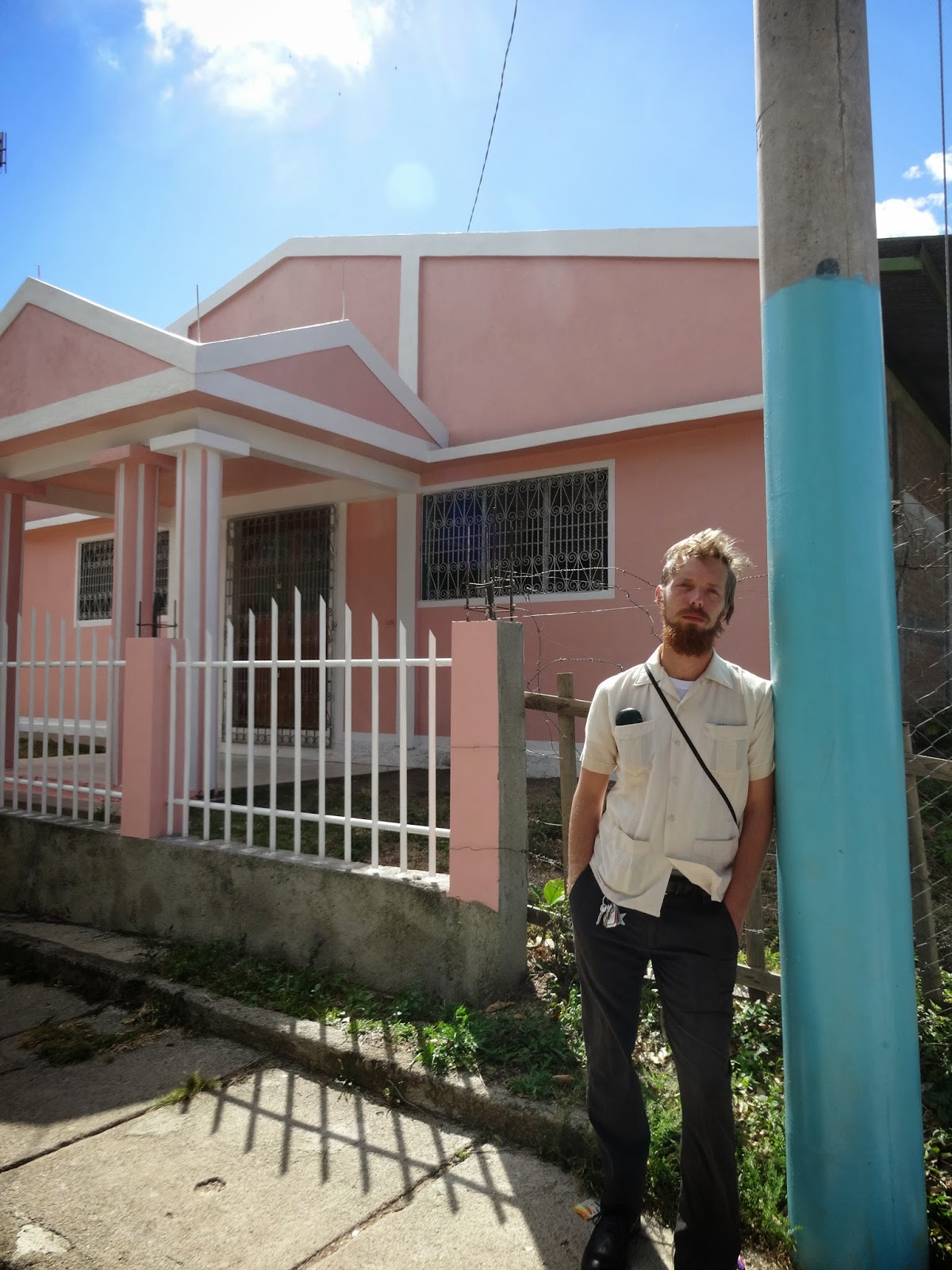
Wednesday, February 12, 2014

School Starts Again

After a two-week vacation to Costa Rica, visiting all of the places where Davie lived when he was younger, we returned to San Nicolas this past weekend and started a new school year two days later.

The school is one of the first buildings you see as you enter the town of San Nicolas. Painted white and blue, it is very hard to miss. There are five classrooms in a row, accented by broken windows and re-bar. In front of these stands the principles'/teachers' office, a cramped space with many desks, file cabinets, and odds-n-ends. Surrounding these buildings, there are four latrines (most of them unusable), a concrete basketball court, and a run-down garden waiting to be tilled.

The school year here in Nicaragua runs from the middle of February until the end of November, and since we didn't get here until October, this will be our first full year of classes. We've conducted a survey with a representative handful of students to determine what they did over vacation, and from the data we've gathered, two primary activities emerged: 1) Sleeping, and 2) Watching TV. From these results, we have concluded that it is about time to dig out the old pens and notebooks de nuevo.

As a bit of background, San Nicolas is the municipal center, or sort of umbrella, for the 40 or so tiny communities that surround it. Most of these communities have their own primary schools, but San Nicolas has the only secondary school in the municipality. Since many of these communities are miles away on terrible dirt roads, and since very few people own cars, lots of students have to walk for hours every day if they want to get a secondary school education. For the students who live even farther away and can't possibly walk that far every day, the school in San Nicolas holds classes every Saturday.

As it is the beginning of the year, we've been working on class scheduling with the other teachers. How they structure the schedule here is a bit different from how high schools in the US usually work. Instead of the students going to different classrooms for different subjects, here the teachers switch classrooms. Each grade (7th through 11th) has its own classroom, and every 45 minutes a different teacher comes into each classroom to teach a different subject. This seems to work fairly well; the only down side is that the teachers don't have their own space to decorate the classrooms with educational materials relevant to the subject they teach.

Discipline is a pretty big problem at the Instituto Publico Carolina Camas Arauz (which is the secondary school's official name). Once you've spent a good half hour observing the students chasing each other madly around the school building while classes are in session, the list of school rules posted in each classroom starts to seem a little ridiculous. (My favorite rules from that list: Boys are not allowed to have long hair or long fingernails. No students are allowed to have boyfriends or girlfriends).

It is pretty much impossible to keep students in their seats, or even in the classroom for that matter, during class. The younger grades are especially crazy; we've learned that trying to play educational games just breeds shouting and chair-standing. But the second that any of the students spots Idalia, the principal, they all inevitably run to their chairs, shut their mouths, and pretend to be writing something. So far, Idalia is the only leverage we've discovered to command good behavior.

The style of education that our students are used to is rote memorization. The school can't afford textbooks, so the teachers write their lessons on the board and students copy them into their notebooks. Unfortunately, this makes for very little creativity or critical thinking. We are beginning to realize that our students are not really accustomed to thinking for themselves. One of our goals this school year, therefore, is to teach them that there are often many right answers, and to encourage them to have the intellectual self-confidence to volunteer their own unique answers.

The school already employs a full-time English teacher, so this year Davie and I will divvy up the during-the-day English classes, so that one of us will support that teacher in every class, helping with pronunciation and classroom management. We are also planning an after-school English class that we will offer for high school students on Mondays and Wednesdays, and an English class for teachers after school on Friday. Some of the little kids in San Nicolas have also expressed interest in learning English, so we're planning on doing a more informal class for them on Saturdays as well.

Wednesday, January 22, 2014

Paz y Potrerillos


In all the spare time we've had during the school vacation over the past two months, Davie has been laboring away, creating a garden from the dry dirt in our back yard. We've planted papaya, zucchini, tomato, pepper, celery, basil, and mint. So when our friend Pedro whipped out a bag full of ginger – my favorite spice ever – to sell at the market last Friday, Davie was all aflutter, wanting to know how he had grown it and what other delicious produce he was hiding from us on his little farm. Obligingly, Pedro invited us to come over to his house the next day.

So on Saturday we hiked an hour through the mountains along the dirt road to Pedro's house in the community of Potrerillos. It was a little adobe house with an orange tree out front, nestled in the complete silence of this remote community. After offering us the obligatory too-sweet cafecito, Pedro took us on a tour of his farm.

At first glance, it didn't look like much. He showed us the fields of green onions and cabbages, where his brothers and father were working, and then took us up to an area that looked to be covered in weeds. But then he started pulling those weeds up, one by one revealing them to be ginger, cilantro, onions, oregano, lemongrass. And with each delicious new herb that he unearthed, he gave us some to plant or eat.

On and on the magical farm-of-hidden-produce went. We hiked up through thickets of banana trees and Pedro pulled up a “malanga,” a potato-like vegetable that people deep-fry to make “tajadas,” or chips. He gave us the malanga and threw its buds back into the ground to sprout anew. He took us to see his garden of chamomile and red lettuce, which grow well together, he said. And then, before heading back to the house, he hacked down a long stick of sugar cane with his machete, peeled it, and cut off bits of it for us to chew on.

By the time we got back to his house, Pedro's sister had cooked up some beans and tamales for us for lunch. After lunch, Pedro climbed up the orange tree in front of the house and picked all of the ripe oranges, tossing them into a sack for us to take with us. We tried to give him some money for everything he had given us, but he refused it, and we walked away weighted down with a huge sack of just-picked produce.

Since we were already in Potrerillos, we decided to go visit our friend Maria, who lives just next door to Pedro. Maria is the only teacher at the primary school in Quebrada de Agua, just down the road, and I tutor her in English.

When we got to her house, Maria was out back doing laundry while her husband showered with their three kids. She invited us into their kitchen and I helped make some orange juice with oranges she had just picked, while she made cuajada, a kind of cheese. Pigs and chickens wandered into the kitchen while we talked, and her kids scared them off. Her daughter sewed dresses for her doll from scraps of old pillowcases and showed them off to me.

Before we left, Maria loaded us up with the cuajada she had just made and three eggs that the chickens had just laid, and sent Lenard Paul, her oldest son, to accompany us up the hill. We would have to come back sometime, she said, so Davie could slaughter one of their chickens and she could teach us how to make chicken soup.

When we got to the road that descends to San Nicolas, a little snag-toothed boy who we had never seen before road up to us on his bicycle. “Hi!” he said (in Spanish), “What's your name?” We introduced ourselves and he introduced himself, and then he said, “Okay, I'll see you on Sunday!” and rode off on his bike. Having never seen this boy before, we thought it was pretty funny that he was so confident that he would see us on Sunday. We laughed and went down the hill to San Nicolas.

But the next day at mass, during the offering of the peace, there was that same snag-toothed little boy. He came up to us, smiling shyly, offering his hand, saying, “Paz.”

Tuesday, January 14, 2014

VMM Retreat 2014

This past week, we journeyed just down the road to La Garnacha for Volunteer Missionary Movement's annual retreat. We spent four days with the other missioners who work in Managua, El Salvador, and Guatemala, as well as with VMM's director and local coordinator. We've been plugging along here in San Nicolas at work and Spanish-learning and friend-making for three months now, so this retreat was a much-needed respite.

During our time in La Garnacha, we did some self-reflection workshops, ate a lot of beans, did a little hiking, spoke a lot of English, and just generally got to know our fellow missioners better. They are a great group of people doing really important work all over Central America, and even though we don't see them all regularly, it is good to feel that we are all working for the same overarching cause, under the single banner of VMM. Therefore, we think that we owe them an introduction.

Kelsey and Erika, Centro Cultural Batahola Norte, Managua, Nicaragua


We see Kelsey and Erika fairly often because they are the only other missioners living in Nicaragua. Because they live in the south and own a feline (and because we are a little obsessed with Game of Thrones right now), we like to pretend that they are the Lannisters. But they are actually quite pleasant people.

Kelsey and Erika both teach English at the cultural center in their neighborhood of Managua, an innovative organization that emphasizes the arts and social justice within the local community. Erika and Kelsey also work with some of the programs at the center dealing with women's issues and violence prevention. You can check out their blog here: http://bataholavolunteers.wordpress.com/

Bethany, Katy, and Tommie, SHARE, San Salvador, El Salvador


Bethany, Katy, and Tommie have worked at SHARE for varying lengths of time, but they are all fluent in Spanish and very passionate about their work. SHARE is an organization that struggles, in an overall sense, for human rights and social justice for the people of El Salvador.

Bethany works a lot with the victims and families of victims of the Salvadoran civil war of the 1980s, among other things. Katy coordinates the delegations that come from the United States to support SHARE's different programs, and Tommie works with SHARE's “literacy brigade” to increase literacy in El Salvador. All of them help out with the various protests against human rights violations that seem to be common in San Salvador. You can learn more about SHARE on its website: http://www.share-elsalvador.org/

Pieter, CAPAZ, Quetzaltanango, Guatemala


Pieter is a gregarious Dutchman who has worked in Guatemala for 20 years. He lives in Chiapas, Mexico with his family (including grandchildren!), and makes a 6-hour commute to work in Guatemala.

Pieter is especially cool because he actually founded the organization CAPAZ. He helps educate indigenous Mayan farmers about how to properly raise and care for their animals – an effort that improves both their income and their diet. CAPAZ also teaches classes on alternative energy systems. Here is CAPAZ's website: http://www.fundacioncapaz.org/en/


Footnote – checked off of our 2014 to-do list: hiking to the Cerro Apaguaji. It's only two weeks into January, and I've already done it twice – once with our friends Nidia and Fatima, and once during our VMM retreat. It's a steep climb, but from the top you can see all the way to Honduras, and on the way back you have a chance at a free bunch of kale from the fee-collector, who also happens to have an abundant garden!

Friday, January 3, 2014

What will Sarah and David be doing in 2014?

Picking coffee
We began 2014 munching on samosas in the streets of San Nicolas as we watched muñecos explode around us. We had gone to mass earlier in the evening, and then over to the parish for a meal of molé poblano with Padre Patricio and the oblates, Mary Luz and Carolina.

When we came home, we decided to make a batch of midnight samosas to go with the pricey champagne we had bought in Esteli. Just before midnight, we started to hear fireworks in the streets outside our house. The Nicaraguan New Years tradition is to make “muñecos,” or scare-crow-style figures, fill them with explosives, and light them off at midnight. I had imagined the muñecos soaring into the sky like fireworks and was therefore a little disappointed when they just kind of flamed and made loud noises. But it was fun to be out on the streets with other San Nicolaseños, watching the muñecos, at what would usually be deemed an unseemly hour to be awake.

As we start 2014, here are a few of our resolutions for the coming year:

-Floss more regularly. But for real . . .
-Start an after-school book club of some sort
-Plant and grow a garden in our back yard
-Find strawberries for our garden
-Learn more about the 1980s Contra war in this area through oral histories
-Learn how to make nacatamales
-Decide whether to keep Diego, the dog recently bequeathed to us by our friends Idalia and Marlon
-If we keep Diego, put some pounds on his skinny ribs (donations are welcomed)
-Hike to Cerro Apaguaji, a scenic mountain that overlooks the lands southwest of San Nicolas
-Visit a women's cooperative in Potrerillos that makes jams
-Continue our cooking club with neighborhood kids
-Compile the Nicaraguan recipes we've collected into a cookbook
-Work with the P.E. teacher, Reinaldo, to develop some after-school sports teams
-Fix the leaks in our roof
-Learn how to do the elaborate braids that so many little girls have
-Continue tutoring adults in the community in English
-Try eating only beans and rice for a whole month
-Spruce up the natural medicine area in front of our house
-Host a small group with community friends
-Help La Garnacha, the local organic farm, improve their website and communications materials
-Milk more cows
-Buy more tortillas from Dona Victoria across the street
-Build a wood-fired oven
-Learn how to make cheese
-Get bikes
-Visit Costa Rica and Davie's friends there
-Finish the Game of Thrones book series
-Teach English to a class of little kids, a class of high school students, and a class of teachers
-Bake stuff
-Visit the Isla de Ometepe in the middle of Lake Nicaragua
-Practice my Spanish with our friend Fatima, who works at the pharmacy next door
-Teach computer classes to high school teachers

-And of course, most importantly, continue expanding and deepening our friendships with the people of San Nicolas

Thursday, December 26, 2013

A Reverse Manger Scene

It has been a painful Christmas week here in San Nicolas. 

This past Monday, a man who lives down the street from us, Tonito, was thrown from his horse and died a few hours later, leaving his wife and seven children to mourn his death just two days before Christmas. Then yesterday, on Christmas day, we heard our friend and neighbor Henry sobbing uncontrollably in his back yard. He called Davie's name through his tears and told Davie from across the fence that his uncle had just died across the street.

We had created a joyful space within the walls of our house on Christmas day, cooking some hearty American comfort foods and skyping with our families. And when we opened our front door to go to the vigil for Henry's uncle, it certainly wasn't joy that greeted us in the streets of San Nicolas, but it also wasn't the outright hopelessness that we had expected.

A huge crowd of people lingered in the street outside our house. We followed them into the house across the street from us and into its living room, where Aurelio, Henry's uncle, lay motionless on a bed in the empty room,. He had died less than an hour before. Family and friends filed into the house, crowding around the bed to lay hands on him and pray. Little kids zoomed in between people's legs to get a look at Aurelio and then went back out into the street to play games.

It seemed that most of the community of San Nicolas was gathered around Aurelio, next to his bed, in the living room, and in the street outside the house, in the moments after his death. It occurred to me that on this Christmas night, we were witnessing something akin to a reverse manger scene, with the shepherds and wise men gathered instead around a very human death.

We were also struck by the fact that this death was such a public, community event; we saw almost everyone we know in San Nicolas there. I had never really thought about how private our death traditions are in the US before – they occur within hospital walls, surrounded only by close family. In contrast, it was fascinating and beautiful to see the entire community surrounding Aurelio, talking and even laughing about his life, at the scene of his death.

This afternoon, the community of San Nicolas walked down the main street, bearing Aurelio's casket. We joined the long procession of people, and even though we didn't really know Aurelio, somehow marching down the streets of San Nicolas with everyone in town, even at this sad moment, made us feel so much a part of this community.

We walked along next to the mariachi band, who blended their violin and trumpet tunes with the wails of Aurelio's family. And there at the cemetery, with the entire population of San Nicolas looking on, Aurelio was put to rest in the ground, as the sun set over the mountains around San Nicolas.


As we're surrounded by the Christmas joy of birth and love, it is uncannily beautiful to see how the sorrow of death here in San Nicolas is inextricable from the love within this close-knit community – how, in essence, joy and sorrow can be such close companions.

Sunday, December 22, 2013

Recipe: Jalapeño Chicken

One day a few weeks ago, Idalia, the director of the school in San Nicolas, came over with her daughter to teach us how to make a standard Nicaraguan dish: jalapeno chicken. 

It being a food-oriented time of year, we want to share this recipe with you. For those of you who are in a cold climate, this dish will warm you quite well. 


For the chicken:


3 lbs chicken, cut into filets
1 clove of garlic, smashed and diced finely
1 lime, juiced
2 small green peppers, diced finely
1 small onion, diced finely
½ teaspoon black pepper
1 teaspoon salt

Juice the lime and combine it with the chicken and diced garlic. Let sit for a minute and then drain the additional liquid. Dice the peppers and onion finely and combine the rest of the ingredients with the chicken. Cook the filet and vegetables, discarding the liquid, in a pan with butter until it is browned and crisp. You can also cook it over a grill if you prefer, Arrr Arrr Arrr.

For the sauce:


2 julienne-cut onions
1 or 2 julienne-cut jalapeno peppers (the more the merrier)
2 cups water
2 tablespoons corn starch
½ cup milk
½ cup sour cream
salt

Cut up the onions and peppers and saute them in oil. When they are cooked, add the water and cook until the water is hot. In the mean time, mix together separately the corn starch, milk, and sour cream. After the water is hot, add the corn starch mixture to the onion and peppers. Cook until the sauce thickens and add salt for taste. You may think, “that is a lot of jalapenos,” but the milk and cream will cut the spiciness - don't worry.

Mix together the chicken and sauce or serve them separately. Eat this dish over rice, with the side of beans that is essential to every Nicaraguan meal.

Merry Christmas and a Happy New Year from San Nicolas, Nicaragua (Santa's vacation location)!

Monday, December 16, 2013

Graduation Season

We have been to three graduation, or promocion, ceremonies in San Nicolas in the last week, and let us just say, they are no small matter. Each ceremony is not only a graduation, we discovered, but also a reunion and a church service, all wrapped up into one four-hour-long service. All said, we have spent more time watching people graduate in the last week than we have spent cooking or eating or maybe even sleeping. (That last one is only a slight exaggeration). And when we do sleep, the graduation theme song haunts our dreams.

The first graduation service we went to was for our friend Fatima, who works at the pharmacy next door to us and was graduating from a local agricultural school. We were invited to the second graduation by our friends Samari and Tamara, sisters who were graduating from 6th grade and kindergarten respectively. The final ceremony, last Saturday, was for our students graduating from high school.

Working on the banner the night before graduation
From our estimation, here are the essential ingredients to a promocion service in San Nicolas, Nicaragua:

  1. The graduation theme song, which is different from the one used in American graduation services, but equally as repetitive.
  2. Balloons, especially white and blue balloons for public school graduations.
  3. Female audience members wearing 6-inch heels and tight glittery dresses.
  4. A rousing sermon and some heartily-bellowed hymns.
  5. A large congratulatory banner; drop-shadow letters are mandatory.
  6. Walking down the aisle with a parent or sibling.
10 a.m., David waits outside the locked church
We also learned this week that when someone tells you that a graduation starts at 10 a.m., they really mean that the graduates start thinking about donning their gowns at 10 a.m. If you go to the church at 10 a.m. for the graduation, the church doors will most definitely be locked, and no one else will be there. 

But in spite of the long, sometimes-boring nature of the graduation services, we were honored to be invited to attend all of these ceremonies, and to watch the pride in our students' eyes as they walked down the aisles in their graduation gowns. So many students have to drop out of school early to work in their family's pulperias or take care of a sibling or child, that graduating from high school is a huge accomplishment, and graduating from a post-high school program is even more admirable. At the high school where we teach, you can see the drop-out progression when you look at the numbers of students in each class. In our 7th grade class, there are over 30 students; in 11th grade (the final year of high school), there are about 12. 

Jarol with his mother, Dona Victoria
The school offers GED-like classes on Sundays as well for adults who never graduated from high school, and we have become friends with Jarol, one of these students. After the graduation ceremonies, we were invited to parties at a few different students' homes, including Jarol's. Jarol is this big bulky manly-man who once made fun of me for complaining of an ant bite ("Come on, you are so much bigger than it!"), but he was visibly glowing with pride after graduating from high school. 

We are so happy for all of the students who graduated from the different programs in San Nicolas this last week, and we want to congratulate them and honor their accomplishments by posting a few photos of them.

Tamara graduating from kindergarten


Samari graduating from sixth grade

Fatima and her dad

Our neighbor, Juan Ariel, with his mother Dina